Yoshiro
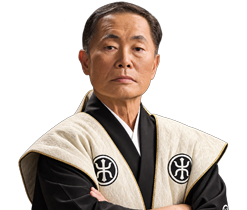
Actor: George Takei
Name: Yoshiro*Title:* Emperor of the Land of the Rising Sun*Nationality:* Japanese*Affiliation:* Empire of the Rising Sun*Regime:* Militarist imperial monarchy*Heir:* Prince Tatsu*Doctrine:* Bushido, divine right and imperial destiny*Commanders:* Shinzo Nagama, Kenji Tenzai, Naomi Shirada*Conflict:* Third World War*Game:* Red Alert 3
Fate: Varies depending on the campaign; killed in the Soviet campaign.Yoshiro is the Emperor of the Empire of the Rising Sun during the Third World War. A long-reigning sovereign, he is regarded by a large proportion of his people as a living god and exercises both political and spiritual authority over the Empire.
A staunch traditionalist, Yoshiro strictly adheres to bushido, the ‘way of the warrior’, and regards honour, loyalty and sacrifice as the foundations of Japanese power.
He is also convinced that his accession to the throne is a matter of divine right and that the Land of the Rising Sun has an equally sacred destiny:to rule the entire world.
The Divine Emperor
This conviction lends the Empire’s expansionist policy an almost religious dimension.
For Yoshiro, the war against the Allies and the Soviet Union is not merely a geopolitical conflict. It represents the fulfilment of Japan’s historic destiny.
He maintains a calm and solemn demeanour at all times, rarely expressing his emotions openly and generally speaking as if he were conveying an ancient truth.
This personality helps to reinforce his image as an unapproachable, quasi-divine monarch.
His commanders are therefore not merely fighting for a government: they are serving a man whom a section of imperial society regards as sacred.
Yoshiro and Tatsu
Yoshiro’s son and heir is Prince Tatsu.
Both men share the goal of making the Empire a superpower, but their conceptions of power differ greatly.
Yoshiro represents tradition.
Tatsu, who is much younger and open to outside influences, represents, by contrast, the technological modernisation of the Empire of the Rising Sun.
Much of the development of the Land of the Rising Sun’s most advanced weaponry is in fact due to this new generation, embodied by Tatsu.
This conflict, however, does not prevent the son from feeling a deep loyalty towards his father.
Tatsu remains the imperial heir and seeks to protect the Empire, as well as Yoshiro’s position, when the war begins to turn against them.
Entry into the Third World War
The Empire of the Rising Sun emerges at a time when the Soviet Union and the Allied Forces are already embroiled in another major war.
Yoshiro regards this situation as a historic opportunity.
With the two great Western powers busy fighting each other, the Empire can launch its offensive and impose its own world order.
Imperial forces then strike simultaneously at several Soviet and Allied territories.
The sudden emergence of this third superpower completely transforms the war.
The former enemies are even eventually forced to consider a temporary alliance against the Empire.
War against the Soviet Union
Yoshiro initially focuses a significant part of his attention on the Soviet Union.
His commanders launched a vast offensive against the eastern territories of the USSR, using the Land of the Rising Sun’s technological and naval superiority to overwhelm several Soviet positions.
Officers such as Shinzo Nagama played a major role in this strategy.
Shinzo is, in fact, one of the Emperor’s most loyal servants and one of the principal architects of the invasion.
Turning against the Allies
Yoshiro quickly realises, however, that crushing the Soviets will not be enough.
The Allied Forces also represent a major obstacle to the Empire’s world domination.
He therefore gradually orders his commanders to shift their efforts against the Allies, particularly in the Pacific theatre.
The war then becomes a true three-way conflict.
Yoshiro must simultaneously prevent a Soviet resurgence and break the Allied military power.
The Imperial Campaign
In the campaign of the Empire of the Rising Sun, Yoshiro acts as the sovereign who directly entrusts major operations to the Commander.
As the latter racks up victories, the Emperor places ever greater trust in him.
The Imperial forces repel the Soviets, engage the Allies and eventually take the war right to the heart of Europe.
The ultimate objective becomes Amsterdam, home to FutureTech, a symbol of the Allies’ technological superiority.
The Imperial offensive ultimately leads to the collapse of the last major pockets of Western resistance.
In this branch of history, Yoshiro’s vision is realised: the Empire of the Rising Sun becomes the world’s dominant power.
He is then able to celebrate victory with Tatsu and his Commanders, convinced that the imperial destiny he had been proclaiming from the outset has been fulfilled.
Soviet Campaign: Killing a Living God
His fate is radically different in the Soviet campaign.
Having repelled the imperial forces, the Red Army decides to strike directly at the spiritual heart of the Land of the Rising Sun.
The mission is given an extremely symbolic objective: to assassinate Yoshiro himself.
The Soviet Commander and Nikolai Moskvin are sent to Japan to ‘tame a living god’.
The principal imperial commanders attempt to defend their sovereign.
But the Red Army gradually eliminates the Japanese defences and finally reaches the Imperial Palace.
Yoshiro’s final battle
When his forces are overwhelmed, Yoshiro refuses to flee.
He personally leaves his Palace and boards a red King Oni specially reserved for the Emperor.
This choice is entirely consistent with his philosophy.
Yoshiro has spent his entire life glorifying bushido, honour and death in battle.
So, as his Empire crumbled around him, he chose to fight in person rather than surrender.
Soviet forces eventually surrounded his King Oni.
Yoshiro was killed in action. The Emperor’s death sends shockwaves throughout the Empire.
For the Japanese, who regarded him as a living god, this is not merely the loss of a leader: it is the collapse of a central pillar of their political and spiritual order.
Tatsu after Yoshiro
Tatsu is deeply affected by his father’s death.
He regards the Soviets responsible for Yoshiro’s assassination as barbarians without honour.
The Emperor’s death also leaves the prince as heir to imperial power.
This succession becomes particularly significant in the sequel to Uprising, where the former Empire is defeated and Tatsu must find a way to preserve Japan under Allied occupation.
It is precisely this far more pragmatic policy that will provoke the anger of traditionalists such as Shinzo Nagama.
Yoshiro and Shinzo
Shinzo is probably one of the men who most perfectly embodies Yoshiro’s vision.
He shares his faith in bushido, honour, tradition and imperial destiny.
Following Yoshiro’s disappearance, Shinzo therefore refuses to accept the changes taking place in Japan under Tatsu.
His rebellion in Uprising can be interpreted as an attempt to preserve Yoshiro’s ideological order following the Emperor’s own demise.
This explains why Yoshiro’s death remains a major political event long after the war.
A sovereign faced with a temporal paradox
Finally, there is one very interesting aspect concerning Yoshiro: for most of the war, he remains unaware that his own Empire is indirectly the product of a Soviet temporal alteration.
Cherdenko, Krukov and Zelinsky eliminated Albert Einstein in 1927.
This intervention altered the world’s technological and geopolitical development, notably enabling Japan to become the superpower led by Yoshiro.
This lends a particular irony to his convictions.
Yoshiro is convinced that the dominance of the Land of the Rising Sun constitutes a divine destiny etched into history.
Yet the history in which his Empire becomes a superpower is, in fact, anything but immutable: it exists precisely because three Soviets artificially altered the past.