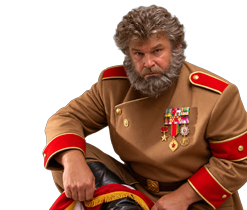
Vladimir
Actor: Adam Greggor
Name: Vladimir*Nationality:* Soviet*Affiliation:* Soviet Union*Rank:* General*Role:* Commander, then head of the Soviet occupation forces in the United States*Superior:* Tsar Alexander Romanov*Rival:* Yuri*Conflict:* Third World War*Appearance:* Command & Conquer: Red Alert 2
Status: Unknown in the Soviet campaign; likely captured in the Allied storyline.Vladimir is one of the Soviet Union’s leading generals during the Third World War. A competent Officer respected by Alexander Romanov, he plays a major role in the invasion of the United States. However, his military effectiveness is accompanied by an arrogant and self-centred personality; in particular, Vladimir has a tendency to take credit for some of the successes achieved by his subordinates.
The invasion of the United States
At the start of the Soviet campaign, Vladimir takes part in the offensive against the American coast. In particular, he commands a Dreadnought during the attack on an Allied naval base in Florida, where he fights alongside the Soviet Commander.
His successes enable him to further win Romanov’s trust. Following the Soviet advance into American territory, Vladimir is eventually appointed head of the occupation forces in the United States and takes up residence in the White House.
He quickly adopts certain aspects of the American way of life, which he nevertheless claims to despise, a fact that reinforces the deliberately caricatured nature of the character.
The destruction of Chicago
In the Allied campaign, Vladimir is directly responsible for one of the deadliest events of the war.
Following the Allies’ destruction of the Chicago Psychic Amplifier, he decides that the city is no longer of any use to the Soviet Union and orders the use of a nuclear weapon.
Chicago is destroyed, along with a large proportion of the forces stationed in the city. This attack prompts the European powers to step up their support for the United States, on condition that the Soviet nuclear facilities threatening Europe are first neutralised.
From the Allies’ perspective, this decision makes Vladimir directly responsible for the nuclear destruction of a major American city. His fate following the Soviet defeat is not specified; he would likely have been held to account for this act had he been captured.
Vladimir versus Yuri
During the Soviet campaign, Vladimir gradually realises that Yuri is manipulating Romanov.
When the Premier, growing increasingly frail, appoints Yuri as supreme commander of the Soviet forces, Vladimir openly accuses the psychic adviser of being a traitor. This opposition makes him a direct obstacle to Yuri’s ambitions.
Shortly afterwards, Romanov is found dead.
Yuri immediately accuses Vladimir of the murder and presents evidence intended to convince the Soviet Commander of his guilt. Vladimir is declared a ‘non-person’ and his forces are deemed traitors.
The Fall of Vladimir
Barricaded in the White House, Vladimir attempts to resist the forces sent against him.
The Soviet Commander eventually takes Washington and Vladimir is discovered hiding in a cupboard. He then desperately tries to reveal that Yuri is lying and that he is the one truly responsible for the events.
Yuri intervenes psychically before he can finish his explanation and neutralises his mind. Vladimir is then taken off-screen, whilst Yuri declares that he is now of no further importance. His exact fate is never shown; he may have been executed subsequently.
Vladimir’s accusations were, however, justified: Yuri had indeed murdered Romanov and framed Vladimir in order to eliminate one of his main rivals. The Prime Minister’s final recording would subsequently enable the Soviet Commander to discover the truth and turn against Yuri.
Personality
Vladimir is an experienced, courageous and genuinely competent Officer, but he is also vain, arrogant and opportunistic. His closeness to Romanov and his successes lead him to have a very high opinion of himself.
His time in the United States further accentuates this trait: whilst Soviet propaganda condemns capitalist decadence, Vladimir has no qualms about enjoying the comforts afforded by his status as an occupier.
He does, however, possess one essential quality: he recognises the threat posed by Yuri before much of the Soviet high command does. His opposition to the adviser is therefore not merely a power struggle, but a well-founded accusation.