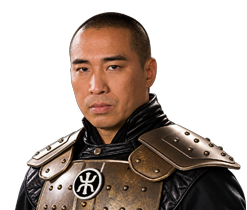
Tatsu
Actor: Ron Yuan
Name: Tatsu*Nationality:* Japanese*Affiliation:* Empire of the Rising Sun*Titles:* Crown Prince, Supreme General, then Emperor*Role:* Deputy Commander of the Imperial Forces*Father:* Emperor Yoshiro*Specialities:* Military modernisation, Nano Tech and advanced technologies*Related creations:* Shogun Executioner, Rocket Angels*Subordinates / associates:* Imperial Commander, Shinzo Nagama, Kenji Tenzai, Takara Sato*Enemies:* Soviet Union, Allied Forces*Conflicts:* Third World War, Uprising*Games:* Red Alert 3, Red Alert 3: Uprising
Status: Defeated by the Allies at the end of the Allied campaign in Uprising.
Tatsu is the son and heir of Emperor Yoshiro and one of the leading political, military and scientific figures of the Empire of the Rising Sun during the Third World War.
Unlike his father, who was deeply attached to traditions and bushido, Tatsu received a Western education. He believes that the Empire cannot fulfil its destiny by relying solely on the traditions of its ancestors: it must also possess the world’s most advanced military technology. The Red Alert 3 manual describes him as far more impatient and scientific than Yoshiro, his intelligence having played a major role in modernising the Japanese army.
Tradition versus modernity
This is the fundamental difference between Tatsu and Yoshiro.
Yoshiro looks to the past. Tatsu looks to the future. The father believes deeply in the Empire’s divine destiny, in honour and in the teachings of the ancestors.
The son respects these principles, but believes that the modern world demands a far more pragmatic approach. He does not hesitate to question some of Yoshiro’s decisions when he feels they jeopardise victory.
Nevertheless, he remains deeply loyal to his father for the greater part of the war.
Their disagreement therefore centres less on the objective than on how to achieve it: both want the Land of the Rising Sun to dominate, but Tatsu regards science and technology as indispensable to this conquest.
The architect of the modern Imperial Army
Tatsu is directly responsible for a large part of the modernisation reforms of the Imperial Army.
In particular, he is associated with the development of:
- Imperial Nano Tech;
- the Rocket Angels;
- the gigantic Shogun Executioner.
The contrast is intriguing: the Land of the Rising Sun’s army displays an extremely traditional feudal aesthetic - samurai, shoguns, the divine emperor - yet simultaneously utilises some of the most futuristic technologies on the planet.
Tatsu is precisely the figure who bridges these two aspects.### The Shogun Executioner
His most spectacular creation is the Shogun Executioner, a gigantic combat robot with three faces and three arms.
Tatsu deploys it against the Soviet Union during the imperial campaign.
The machine is used during the assault on Odessa, where it proves virtually impossible to stop with conventional weapons.
This offensive enables the Japanese, in particular, to crush the forces of Nikolai Krukov and Nikolai Moskvin.
The Shogun Executioner perfectly illustrates Tatsu’s military philosophy: to take traditional Japanese imagery - in this case that of the warrior and the shogun - and transform it into a gigantic technological weapon.
The Third World War
Tatsu plays a direct role in the conduct of the war alongside Yoshiro.
During the Imperial campaign, his father introduces him to the Imperial Commander, and Tatsu helps to plan the destruction of the Soviet Union.
However, he proves to be far more pragmatic than the Emperor.
As the war becomes increasingly difficult, Tatsu begins to question some of his father’s strategic decisions.
Pearl Harbor
In particular, the Imperial intelligence network discovers that an Allied offensive is being prepared against Pearl Harbor.
Tatsu uses this intelligence to enable Japanese forces to prepare their defences and send reinforcements before the enemy arrives.
This section clearly illustrates his role: he does not merely oversee imperial technology.
He plays a direct part in the overall military strategy of the Land of the Rising Sun.
The revelation of the temporal paradox
One of the most significant moments for Tatsu comes when he discovers the true origin of the Third World War.
Thanks to the android spy who had replaced the US President Howard T. Ackerman, the Empire intercepts a conversation involving Gregor Zelinsky.
Tatsu and Yoshiro then learn that Cherdenko, Krukov and Zelinsky travelled back in time and erased Albert Einstein from history.
But the revelation has an even more unsettling consequence.
The Soviet temporal alteration has shifted the global geopolitical balance.
In other words, the Empire of the Rising Sun as Yoshiro and Tatsu know it is itself a consequence of the temporal paradox.
Tatsu is stunned.
For Yoshiro, the shock is even greater.
Yoshiro’s crisis
This revelation deeply shakes the Emperor’s convictions.
Yoshiro believed that the rise of the Land of the Rising Sun was part of a divine destiny.
He suddenly realises that this destiny might simply be the accidental result of three Soviets altering the course of history.
At the same time, a Soviet-Allied coalition is preparing to launch a direct attack on Japan.
Tatsu must therefore take on greater responsibility.
Tatsu Takes Command
When the Allied Forces and Soviet Forces attack Japan, Yoshiro finally acknowledges the mistakes that have been made.
He apologises to his son for not having listened closely enough to his advice and hands him his old katana, entrusting him with command of the imperial forces to defend the country.
This is a pivotal moment in Tatsu’s development.
He ceases to be merely the Emperor’s heir.
He effectively becomes the Empire’s military leader.
Under his authority, the Imperial Commander organises Japan’s defence alongside Shinzo Nagama and Yuriko Omega. The Japanese forces succeed in repelling the Soviet-Allied offensive.
Reconciliation with Yoshiro
This victory also enables father and son to reconcile.
Yoshiro regains confidence in the Empire’s future and finally recognises the value of Tatsu’s methods.
Their clash between tradition and modernity therefore does not lead to a rift in this campaign.
It leads to a synthesis.
Yoshiro retains spiritual and traditional authority, whilst Tatsu provides the military and technological vision necessary to continue the war.
Destruction of Moscow
Tatsu then orders the Imperial Commander to take the war directly to the heart of the Soviet Union.
The objective is twofold:
to destroy Cherdenko’s regime and to destroy the Soviet time machine in order to prevent further alterations to history.
The Shogun Executioner is deployed once more.
Imperial forces attack Moscow and finally eliminate Anatoly Cherdenko and Nikolai Krukov.
The Soviet threat is all but wiped out.
Amsterdam
The last major power capable of putting up resistance is now the Allies.
The Empire launches its offensive against Amsterdam, the heart of FutureTech and one of the West’s leading technological centres.
Imperial forces eventually win the battle and break the Allied resistance.
In this branch of history, the Empire of the Rising Sun wins the Third World War.
Yoshiro and Tatsu personally thank the Imperial Commander and reward him for his victories.
Father and son can finally celebrate the dominance of the Rising Sun together.
However, this is the Imperial campaign, which constitutes an alternative branch of the story.
Soviet campaign: the death of Yoshiro
In the Soviet campaign, Tatsu finds himself in a completely different situation.
In particular, he establishes a major complex in Vladivostok, which becomes a target of the Soviet counter-offensive.
Despite the Imperial defences, the Soviets destroy the position.
The real trauma comes later, during the invasion of Japan.
The Soviet Commander and Moskvin attack Mount Fuji and ultimately kill Yoshiro.
Tatsu reacts with fury, accusing the Soviets of being savages without honour.
His fate following this defeat is not specified in this branch.
However, Revolt presents a timeline in which Tatsu did indeed survive the war and his father died.
Red Alert 3: Revolt
After the Third World War, the Empire of the Rising Sun is defeated.
Yoshiro is dead.
Japan is occupied by the Allied Forces.
And Tatsu finds himself at the head of what remains of the imperial government.
His reaction surprises everyone:
Tatsu surrenders.### The Surrender
The prince officially accepts the Allied occupation and begins to collaborate with the victors in order to maintain order in Japan.
The Allies see him as a leader pragmatic enough to administer the defeated country.
But this policy provokes the anger of the former shoguns.
For traditionalists such as Shinzo Nagama, accepting foreign occupation constitutes an absolute betrayal of everything Yoshiro stood for.
Three commanders in particular take up arms:
Shinzo Nagama,
Kenji Tenzai,
Takara Sato.
They refuse to recognise Tatsu’s authority.
Tatsu seeks help from the Allies
Tatsu then contacts the famous Allied Commander from the Third World War directly.
He asks him to help the Japanese government crush the uprising.
The Allies agree.
The Commander and Eva McKenna therefore return to Japan to lead ‘peacekeeping’ operations.
Shinzo Nagama
The first target is Shinzo.
He has entrenched himself in his ancestral region of Shin Iga and is gathering forces loyal to the former imperial order.
Tatsu provides the Allies with intelligence as well as some imperial troops, notably Archer Maidens and Engineers.
The Allies attack the position.
Shinzo is defeated and captured.
Kenji Tenzai
The second major rebel is Kenji.
He, too, rejects Tatsu’s authority and attempts to continue the fight against the occupation.
The Allies eliminate his forces.
Two of Tatsu’s main political and military rivals have now been neutralised.
There is only one left.
Takara Sato
The last is Takara Sato.
A former Rocket Angel who has become a Commander, Takara enjoys immense personal loyalty amongst her Soldiers.
Tatsu claims that she has turned her men against him and that she threatens everything her father stood for.
His rhetoric then becomes much more aggressive.
Whilst the initial operations could still be presented as pacification missions, this time Tatsu asks the Allied Commander to show no mercy towards Takara’s forces.
The Allies obey.
And that is exactly what Tatsu was expecting.
Tatsu’s trap
This is where his character becomes truly interesting.
From the outset, the Allies intended to use Tatsu as a collaborating leader of an occupied Japan.
But Tatsu is using them too.
Shinzo, Kenji and Takara each had their own armies and were challenging his authority.
Thanks to the Allied Commander, Tatsu has just had his three main internal Rivals eliminated.
He can now reveal his true intentions.
The New Emperor
Following the fall of the rebel shoguns, Tatsu proclaims himself Emperor of Japan.
He then turns the forces and equipment recovered after the insurgents’ defeat against the Allies.
The collaboration was over.
Tatsu launches a massive attack against the occupying forces.
His true objective then becomes clear: to restore the independence and power of the Empire of the Rising Sun under his own authority.
He was therefore not simply the compliant leader the Allies thought they had installed.
He was biding his time until his rivals were sufficiently weakened for him to personally regain control of the Empire.
The Fall of the New Emperor
The plan was clever, but Tatsu underestimated his opponent.
The Allied Commander he has just manipulated is precisely the man who had previously helped defeat the Empire during the Third World War.
A new battle breaks out.
Tatsu’s forces use the units seized from the various shoguns in an attempt to crush the Allies.
But the Allied Commander emerges victorious once again.
Tatsu’s attempt at imperial restoration is crushed.
It is with this defeat that the Allied campaign in Uprising comes to an end.
Tatsu: collaborator or strategist?
At first glance, Tatsu appears to have betrayed Yoshiro’s legacy.
His father would have preferred to fight to the death.
Tatsu surrenders and cooperates with the Allies.
But Uprising gradually reveals that this surrender can also be seen as a strategy for political survival.
Japan had lost the war.
Tatsu did not immediately have the means to drive out the Allies.
On the other hand, he could:
temporarily accept their presence → secure their support → send them to fight his rivals → reclaim the forces of the defeated shoguns → reunify imperial power → proclaim himself Emperor → turn against the occupiers. Seen in this light, Tatsu was applying precisely the philosophy that had already set him apart from his father:pragmatism over dogma. Yoshiro would probably have regarded surrender as dishonourable.
Tatsu is willing to accept humiliation for the time being if it enables him to regain power later.
Tatsu and Shinzo: two heirs to Yoshiro
This contrast also merits further exploration.Shinzo Nagama embodies Yoshiro’s ideological legacy: tradition, bushido, absolute loyalty and a refusal to surrender.Tatsu represents his dynastic legacy: he is his son, his successor and the legal heir to the throne.
The conflict in Uprising therefore pits two ways of continuing Yoshiro’s work against one another.
| --- | --- |
| Tradition | Modernisation |
| Strict bushido | Pragmatism |
| Refusal to surrender | Tactical surrender |
| Loyalty to the old order | Rebuilding a new Empire |
| Immediate rebellion | Biding one’s time and manipulation |
And ultimately, it is Tatsu who wins their political showdown: he uses the very Allies that Shinzo refuses to tolerate to eliminate Shinzo.
Tatsu and Yuriko
There is also an interesting connection with Yuriko Omega.
Yuriko seems to hold Tatsu in high regard and considers him a figure who contributed to her rise within the Omega Project.
This fits quite well with the prince’s profile as a scientist and moderniser.