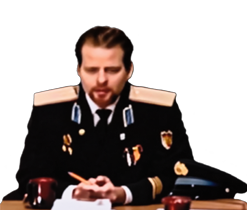
Radik Gradenko
Actor: Alan Terry
Name: Radik Gradenko*Nationality:* Soviet*Affiliation:* Soviet Union*Rank:* Marshal*Role:* High Commander of the Red Army*Superior:* Joseph Stalin*Associates:* Nadia Zelenkov, Georgi Kukov*Conflict:* Alternative Second World War*Game:* Command & Conquer: Red Alert
Fate: Eliminated on Stalin’s orders Radik Gradenko is a Soviet marshal and one of Joseph Stalin’s key military commanders during the war between the Soviet Union and the Allied Forces.
He belongs to the inner circle of Soviet power and appears right from the start of the Soviet campaign in Red Alert. The game immediately portrays him as an Officer perfectly willing to employ the most brutal methods to satisfy Stalin.
The gas experiments
Gradenko first appears at the People’s Revolutionary Headquarters, alongside Stalin.
The Soviets have just tested a poison gas on a civilian population. Stalin personally asks Gradenko how long it takes for the weapon to kill its victims.
The marshal coldly reports the results of the experiment: the children died in less than fifteen seconds, whilst the adults succumbed between eighteen and forty-two seconds.
This scene immediately establishes Gradenko’s character: a brutal Officer, subservient to Stalin and perfectly willing to participate in the regime’s atrocities.
The new Soviet Commander is then given his first mission: to crush the Polish town of Toruń, whose inhabitants have resisted the Soviet occupation. This operation also serves as a test to determine whether the Commander is sufficiently obedient and ruthless to rise through the Soviet ranks.
The Conquest of Europe
Gradenko subsequently plays a part in leading the Soviet offensive against Europe.
The Red Army enjoys considerable numerical superiority, but Allied resistance severely slows the advance.
During an operation preceding the capture of Berlin, Gradenko states in particular that the Soviet Union has fourteen armoured divisions compared with just three Allied divisions.
Nadia is quick to point out to him that these three divisions are, however, sufficient to halt his offensive.
Gradenko then claims that, given the Red Army’s rate of advance,the whole of Europe could be occupied within sixty days. Nadia replies, however, that the offensive is already eleven months behind schedule.
This exchange sums up the relationship between the two characters quite well.
Gradenko represents the traditional military high command– arrogant and keen to preserve his prestige with Stalin – whilst Nadia comes across as much colder, more pragmatic and politically dangerous.
The Allied Spy Affair
As Soviet forces advance into Scandinavia, an Allied spy infiltrates a Soviet gas production facility in southern Sweden and manages to destroy it.
The incident is a humiliation for Gradenko.
Rather than immediately informing Stalin of this failure, the marshal attempts to cover up the affair. Nadia, however, discovers what has happened and reports the situation directly to the Soviet leader.
The Soviet Commander is then ordered to track down the spy before he can join the Allied Forces.
Despite the help of the Swedish resistance and the last remaining Allied Soldiers in the region, the agent is eventually captured and executed.
The episode nevertheless marked the beginning of Gradenko’s political decline.
His mistakes became increasingly difficult to conceal, and Nadia gradually exploited his failures to strengthen her own influence with Stalin.
A Man of Stalin’s
Despite his military difficulties, Gradenko remained for a time one of the officers in whom Stalin personally placed his trust.
This closeness became particularly evident when the dictator’s paranoia reached new heights.
Convinced that several of his generals were plotting to assassinate him, Stalin prepared a new series of purges within the Soviet high command.
Completely drunk, he summoned Gradenko and presented him with a list of officers whom he now regarded as traitors.
Gradenko noted with relief that his own name was not among them.
Stalin explains that he trusts him because Gradenko has always supported him in his ambition to reclaim the territories he considers to have been stolen from Russia.
He then grants him the ‘honour’ of personally signing the execution warrants for the condemned generals.
Gradenko agrees.
This scene is probably the most revealing moment for the character: to retain Stalin’s trust, he agrees to condemn his own comrades and colleagues to death.
The Iron Curtain and Gradenko’s Downfall
But whilst Stalin and Gradenko were celebrating their mutual loyalty, Georgi Kukov and Nadia were secretly watching them via CCTV.
They then discovered a far more serious problem.
Gradenko has abandoned a lorry carrying components of the Iron Curtain, one of the Soviet Union’s most secret technologies. The vehicle has fallen into the hands of the Allies, who intend to examine its contents.
Kukov notices that Gradenko has taken great care not to inform Stalin of this incident.
The Soviet Commander is therefore ordered to destroy the lorry and any Allied Forces likely to escape with the components of the super-weapon.
This mistake politically dooms Gradenko.
Having served Stalin for years and personally taken part in the purges of his Officers, the marshal in turn becomes a liability that the regime must dispose of.
His position in the high command is eventually taken over by Georgi Kukov, who becomes the Soviet Commander’s principal military superior. The latter’s career confirms that Gradenko’s mistakes led to his ousting.
A victim of the system he served
It is this aspect that I would particularly like to explore in relation to Gradenko.
He is not portrayed as a likeable character who was unjustly victimised by Stalin. On the contrary, Gradenko plays a full part in the regime’s brutality.
He oversees chemical weapons experiments on civilians, takes part in the Soviet conquest of Europe, conceals his own failures and agrees to sign the death warrants of other generals to preserve his position.
But no amount of loyalty is enough in Stalin’s system.
When he himself becomes a liability, Gradenko falls victim to the very mechanism he had previously helped to create.
His story, moreover, foreshadows that of several other Soviet leaders: Stalin gradually eliminates his own Officers and advisers, whilst Nadia manipulates internal rivalries to increase her influence.
Gradenko therefore perfectly captures the atmosphere of the Soviet campaign in the first Red Alert: Red Army generals must fear the Allies on the battlefield just as much as they fear Stalin and their own colleagues in Moscow.