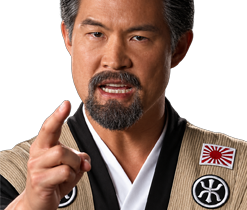
Shinzo Nagama
Actor: Bruce A. Locke
Name: Shinzo Nagama*Nationality:* Japanese\Affiliation:*Empire of the Rising Sun* Organisation:Imperial Shogunate* Rank:Shogun** Role:*Commander* Nickname:‘The Emperor’s Shade’ ”* Speciality:*Infantry, traditional warfare and infiltration tactics* Superior:*Emperor Yoshiro* Associates:*Imperial Commander, Yuriko Omega, Kenji Tenzai, Takara Sato* Enemies:Soviet Union, Allied Forces** Conflicts:*Third World War, Shogunate uprising* Games: Red Alert 3, Red Alert 3: Uprising
Status: Captured and placed in cryogenic detention after the war.Shinzo Nagama is a shogun and one of the most important commanders of the military forces of the Empire of the Rising Sun during the Third World War. An experienced strategist, conservative and extremely loyal to the Emperor, he is notably regarded as one of the principal architects of the Imperial invasion of the Soviet Union.
His importance within the Shogunate earned him the nickname ‘Shade of the Emperor’, a sign of his closeness to Yoshiro and his particularly high status within the imperial hierarchy.
Heir to a military tradition
Shinzo comes from a long line of imperial military advisers.
Unlike some of the younger officers of the Land of the Rising Sun, Shinzo does not place his trust solely in Japanese technological superiority.
Above all, he embodies the imperial military tradition.
He strictly adheres to bushido, the ‘way of the warrior’, and regards loyalty to the Emperor as an absolute duty. His approach to warfare is methodical, conservative and often extremely brutal.
This personality also sets him apart from Kenji Tenzai. In Uprising, Tatsu describes Kenji as a far more arrogant and modernist Commander, whilst Shinzo embodies precisely the old order and its traditions.
Shinzo becomes one of Yoshiro’s most faithful servants.
His loyalty goes far beyond mere military obedience. For him, the Emperor embodies an almost sacred authority, and the war waged by the Land of the Rising Sun represents the fulfilment of his divine vision.
This loyalty explains much of his subsequent actions.
Shinzo is not merely loyal to Japan or even to the Empire of the Rising Sun: above all, he is loyal to the imperial order represented by Yoshiro.
When this order disappears after the war, Shinzo therefore refuses to accept Tatsu’s new Japan.
The invasion of the Soviet Union
Shinzo plays a fundamental role in the preparation of the Japanese offensive against the Soviet Union.
He is explicitly portrayed as one of the architects of the imperial invasion of Soviet territory.
In the imperial campaign of Red Alert 3, he becomes one of the player’s principal commanders.
In particular, he accompanies the Imperial Commander during several major battles:
The Death of Father Frost, Barbarians at the Bay and The Last Red Blossom Trembled.
The Attack on Vorkuta
Shinzo’s first major operation in the Imperial campaign is the attack on a Soviet town in the run-up to New Year.
The Japanese objective is not merely military.
Shinzo and the Imperial Commander seek to undermine the morale of the Soviet population before they even realise that a new power has entered the war.
In particular, the Japanese destroy various Soviet symbols and monuments and annihilate a major force commanded by Oleg Vodnik.
This operation perfectly illustrates Shinzo’s approach to warfare: the physical destruction of the enemy matters, but the destruction of their will to resist is just as important.
The attack also constituted one of the first acts of the Empire of the Rising Sun’s massive invasion of the Soviet Union.
Krasna-45
On other fronts, Shinzo engages the Soviets directly at Krasna-45.
In particular, he sets up a Sleeper Ambush for the Soviet Commander and Nikolai Moskvin.
However, both Soviet officers survive and eventually manage to retake the installation. Shinzo manages to leave the battlefield.
This encounter becomes particularly significant in the Soviet campaign.
Moskvin and the Soviet Commander will later have the opportunity to take their revenge in Japan.
Defence of Yokohama
In the Imperial campaign, Shinzo also intervenes when the Allied Forces and the Soviet Union launch an attack on Yokohama.
The forces of Lissette Hanley and Nikolai Krukov pose a direct threat to Japanese territory.
Shinzo then fights alongside the Imperial Commander and Yuriko Omega to repel the invasion.
This battle also highlights the respect he appears to have for Yuriko.
Despite the highly unusual nature of the Omega programme, Shinzo clearly recognises the young psionic’s extraordinary power and her value as a warrior in the service of the Empire.
The Battle of Amsterdam
During the Imperial campaign, Shinzo finally accompanies the Commander on the decisive offensive against Amsterdam.
The city is home to the headquarters of FutureTech, whose research provides the Allies with their most advanced military technologies.
The Empire therefore decides to destroy the research centre once and for all.
The battle is colossal.
Shinzo and the Imperial Commander face off against the last major Allied Forces as well as Soviet survivors gathered around FutureTech. Robert Bingham and Gregor Zelinsky, in particular, take part in the defence.
The Imperial forces eventually prevail.
FutureTech is destroyed and the Allied resistance collapses. In this branch of history, the victory paves the way for the Empire of the Rising Sun’s global domination.
Shinzo can then set about achieving one of his personal goals: training a new generation of shoguns capable of perpetuating the Empire’s military traditions.
However, this ending is specific to the Imperial campaign and is not the one that leads to Uprising.
Soviet Campaign: Shinzo’s Death
In the Soviet campaign, his fate is radically different.
After several clashes with the Red Army, Shinzo takes part in the defence of Japan when Soviet forces launch their offensive against the Imperial Palace.
The Soviet Commander and Nikolai Moskvin then confront Yoshiro’s principal commanders.
Shinzo is ultimately killed during the battle. His final words once again highlight his obsession with honour: he accepts his own death as that of a warrior loyal to the Empire.
However, this death is not consistent with Uprising, in which Shinzo is very much alive after the Third World War.
I would therefore present it in a small box labelled ‘Alternative Fate’ rather than in the main biography.
Red Alert 3: Uprising
After the war, the situation in Japan is catastrophic.
The Empire has been defeated,Yoshiro is dead and his son Tatsu has succeeded him. Tatsu agrees to cooperate with the Allied Forces, who are now occupying Japan.
For Shinzo, this policy constitutes a betrayal of everything the former Empire stood for.
Yoshiro’s Death
Yoshiro’s death affects Shinzo deeply.
He was regarded as one of the Emperor’s most loyal servants. After his death, Shinzo retreats to his ancestral home in the province of Shin Iga, the region where he grew up.
Officially, the old shogun is seeking to rediscover a form of purity or spiritual guidance following the catastrophe that has just struck his country.
In reality, he is plotting something entirely different.
Shinzo is secretly gathering the Soldiers and Officers who have remained loyal to him.
His aim is now to overthrow Tatsu and restore the former imperial order.
The Shogunate Uprising
Shinzo is not alone.
Two other imperial commanders also reject the new order: Kenji Tenzai and Takara Sato.
All three are gathering their own forces and launching an uprising against Tatsu and the Allied occupation. But Shinzo is identified as the main leader of the rebellion.
The difference between these commanders is interesting.
Kenji relies on modern military technology.
Takara enjoys immense personal loyalty from his Soldiers.
Shinzo, for his part, represents tradition.
His Uprising is therefore not simply an attempt to regain power: it is a reaction against the disappearance of Yoshiro’s Imperial Japan.
End of Tradition
Tatsu quickly realises that Shinzo poses a major threat to his new government.
He therefore seeks the help of the Allied Forces.
The famous Allied Commander from the Third World War is recalled from holiday, accompanied by Lieutenant Eva McKenna, to crush the insurrection.
The primary target is Shinzo.
The Allies enter Shin Iga Province and establish a base near his ancestral home.
They benefit in particular from new technologies from FutureTech, including the powerful Harbinger Gunships.
The Nagama Dojos
Shinzo still has many loyal Soldiers at his disposal.
His forces are organised around his Nagama Dojos, military establishments directly under his authority.
But not all his men share his suicidal determination.
Some realise that the rebellion is doomed and decide to defect. They then provide assistance to the Allied Commander in exchange for sentence reductions.
This is an interesting detail regarding the character’s personality: Shinzo can still inspire great loyalty, but his absolute refusal to accept Japan’s new reality ultimately leads to desertions even within his own ranks.
The Fall of the Nagama Estate
The Allies finally advance to Shinzo’s ancestral estate.
Rather than simply destroying it, they use their cryogenic weapons to freeze it.
Shinzo realises that the battle is lost.
However, the old shogun refuses to surrender immediately.
He attempts to escape in a Sudden Transport, concealed amongst several Tsunami tanks so that the Allies cannot identify the vehicle in which he is travelling.
The ruse fails.
The Allied Commander identifies and freezes Shinzo’s transport before he can leave the area.
The leader of the rebellion is captured.
His remaining forces then lay down their arms and recognise Tatsu’s authority.
Camp Dakota
Following his capture, Shinzo is transferred to Camp Dakota, an Allied detention centre.
He is placed in cryogenic detention.