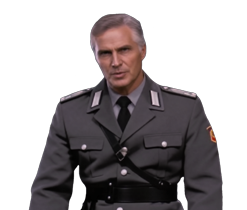
Gunter Von Esling
Actor: Arthur Roberts
Name: Gunter von Esling*Nationality:* German*Affiliation:* Allied Forces / Germany*Rank:* General*Position:* Supreme Commander of the Allied Forces*Deputy:* General Nikos Stavros*Subordinates:* Allied Commander A9, Tanya Adams*Enemies:* Joseph Stalin’s Soviet Union*Conflict:* Alternative Second World War*Game:* Command & Conquer: Red Alert
Mentioned in: Red Alert 3
Status: Retired after the war; subsequent fate unknown.Gunter von Esling is a German general and the Commander of the Allied Forces during the war triggered by the Soviet invasion of Europe. Stoic, pragmatic and highly respected by his subordinates, he coordinates the various European armies fighting against Joseph Stalin.
Unlike many military leaders in the saga, von Esling is not portrayed as a man seeking personal glory. His role consists above all of keeping the Allied coalition united and making the decisions necessary for its survival, even when this involves temporarily abandoning certain territories.
A German general in an alternate history
The very existence of von Esling’s career is linked to the temporal upheaval caused by Albert Einstein.
By removing Adolf Hitler from history in 1924, Einstein prevents Nazi Germany from existing in the form known to us in our reality. However, he does not prevent a new world war: Stalin’s Soviet Union becomes the expansionist power that invades Europe.
Germany is therefore one of the European nations that make up the Allied Forces.
Von Esling, a German General, eventually finds himself placed at the head of this entire coalition.
Supreme Commander of the Allies
When the Red Army invades Europe, von Esling must coordinate forces from several countries.
His principal deputy is the Greek General Nikos Stavros, whilst the most important operations are entrusted to Allied Commander A9, a character played by the player. Commando Tanya Adams also reports directly to von Esling’s high command.
The structure of the Allied General Staff can therefore be summarised as follows:
| Character | Role |
|---|---|
| Gunter von Esling | Supreme Commander and Chief Strategist |
| Nikos Stavros | Deputy Commander |
| Commander A9 | The player’s field commander |
| Tanya Adams | Commando in charge of special operations |
Von Esling thus sets the broad strategic objectives, whilst the Allied Commander carries them out on the ground.
The early defeats
The start of the war is extremely difficult for the Allies.
The Red Army has considerable superiority in armoured vehicles and is advancing rapidly across Europe. Von Esling realises that an immediate head-on confrontation would be catastrophic.
He therefore adopts a much more cautious strategy:to slow the Soviet advance, defend strategic passes and buy enough time to allow European nations to mobilise their forces. Certain positions must be abandoned.
This policy may give the impression that the Allies are constantly being pushed back, but it gradually allows the Soviet lines to be stretched and a counter-offensive to be prepared.
Germany Almost Lost
One scene in particular provides a good insight into von Esling’s character.
When Stavros learns that Greece has been occupied and that his government has been forced into hiding, he reacts angrily and momentarily leaves the Command Hub.
Von Esling then reminds him that his own homeland,Germany, has also all but fallen.
Yet he continues to work.
The contrast perfectly defines his temperament: von Esling seems no less affected than Stavros, but he refuses to let his personal feelings influence the overall conduct of the war.
The Turning Point of the War
As the Soviets make mistakes and overextend their forces, von Esling begins to exploit their weaknesses.
The Allied Commander’s operations gradually enable the coalition to regain the initiative.
The high command then organises a series of missions designed not only to repel the Red Army, but also to destroy the elements that give it its technological advantage.
The Iron Curtain
One of the most significant threats uncovered by the Allies is the Soviet Iron Curtain.
Einstein explains to von Esling that this technology theoretically makes a vehicle or structure temporarily invulnerable.
Von Esling immediately grasps the military implications of such an invention.
He orders several operations against Soviet research centres in order to gather intelligence and halt the project’s development. Despite these attacks, the Soviets nevertheless manage to build operational prototypes.
The Allies, however, succeed in preventing an even more powerful version of the device from being deployed.
Vladimir Kosygin
Another significant operation concerns the Soviet scientist Vladimir Kosygin.
Kosygin wishes to defect and possesses valuable intelligence on Soviet military programmes.
Von Esling organises his extraction.
The scientist is eventually recovered by the Allies, giving them access to important information about Stalin’s secret weapons.
The Chronosphere
At the same time, the Allies are developing their own revolutionary technology: Einstein’s Chronosphere.
Von Esling also oversees operations relating to the first operational prototype. The research eventually provides the Allies with a technological capability capable of rivalling the Soviet super-weapons.
This is a fundamental difference between the two sides: von Esling must constantly adapt his strategy to Einstein’s inventions on the one hand and the Soviet programmes on the other.## The Nuclear Crisis
One of the most dangerous situations of the war arises when the Soviets launch Nuclear Missile Silos at several European capitals.
The Allies must prevent the warheads from reaching their targets.
Commander A9 personally takes charge of the infiltration operation, soon joined by Tanya Adams.
The silos are finally neutralised and Europe narrowly escapes a nuclear catastrophe.
This victory marks one of the last major turning points of the war.
The Soviets have failed to destroy the coalition, and their forces are now beginning to be pushed back towards their own territory.
The invasion of the Soviet Union
Having liberated Europe, von Esling switches from defence to offence.
The Allied Forces advance into Soviet territory.
The objective is no longer simply to drive back Stalin:his military capability must be destroyed once and for all, and his regime overthrown. The Allied Forces advance towards Moscow whilst the last remaining Soviet military installations are gradually neutralised.
Von Esling is finally able to report to the Commander that all Allied divisions are ready for the final offensive.
Moscow
The final operation leads directly to Moscow.
The Allies are gathering their forces for a massive attack on the Soviet capital.
Tanya leads the vanguard, then the main army establishes its base and launches the assault on Stalin’s last defences.
The battle ends in a complete victory.
Stalin is found seriously wounded beneath the rubble.
Nikos Stavros, whose country, Greece, had suffered terribly from the invasion, chooses to leave him to his fate rather than take him back as a prisoner.
The war comes to an end.
And the strategy pursued by von Esling from the outset has finally paid off: to survive the initial offensive, wear down the Red Army, retake Europe and then take the war to the heart of the Soviet Union. Having led the Allies to victory, Gunter von Esling eventually retired in the years following the war.
He left the service with an exceptional reputation and was held in high esteem by the Allied world.
His personal fate after this period is unknown.
His legacy in Red Alert 3
Von Esling does not physically reappear in Red Alert 3, but his name still exists several decades later.
A major Allied facility in Iceland bears his name:
Von Esling Airbase. This airbase is a major strategic stronghold for the Allies. In particular, it serves as a staging area for American forces heading to join their European allies and is home to a significant air force comprising Apollo Fighters, Vindicators and Century Bombers.
In the Soviet campaign of Red Alert 3, it becomes the target of Operation No Traitors Tomorrow.
Soviet forces attack and destroy it.
The mere fact that a major Allied military installation still bears his name therefore shows that von Esling has become a historical figure within the Allied Forces.