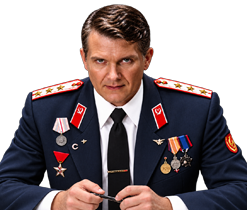
Georgi Kukov
Actor: Craig Cavanah
Name: Georgi Kukov*Nationality:* Soviet*Affiliation:* Soviet Union*Ranks:* Captain, then General*Role:* Red Army Officer, then Red Army Commander*Superior:* Joseph Stalin*Allies:* Nadia Zelenkov, Radik Gradenko, Soviet Commander*Enemies:* Allied Forces*Conflict:* Alternative Second World War*Game:* Command & Conquer: Red Alert
Status: Deceased, killed by Joseph Stalin Georgi Kukov is a Soviet Officer who becomes one of the leading figures in the Red Army during Joseph Stalin’s war against the Allied Forces.
A career soldier, Kukov believes deeply in the power of the Red Army and has considerable confidence in his own tactical abilities. His rise through the ranks directly parallels the Soviet successes in Europe: starting as a senior officer, he eventually rose to the rank of General and succeeded Radik Gradenko as commander-in-chief of the army.
Kukov first appears at the start of the Soviet campaign, as the Red Army continues its westward advance.
He meets the Soviet Commander on the German-Polish border and relays his instructions for a new operation. At this stage of the war, Kukov still held the rank of Captain.
The German forces in the region were quickly overwhelmed by the Soviet offensive.
The Red Army’s successes also enabled Kukov to rise through the military ranks. He was eventually promoted to General, gradually becoming one of the most important Officers in the Soviet Union.
In Gradenko’s shadow
For much of the war, the Soviet high command remained dominated by Marshal Radik Gradenko.
But Gradenko made mistake after mistake.
In particular, he attempted to conceal some of his failures from Stalin and compromised the security of the Soviet Iron Curtain project when a lorry carrying components of this technology fell into the hands of the Allies.
Kukov and Nadia then secretly observed a conversation between Gradenko and Stalin.
They discover that the Marshal has not informed the dictator of the loss of the strategic equipment. The Soviet Commander is therefore ordered to destroy the lorry before the Allies can escape with its cargo.
Kukov thus finds himself gradually drawn into Nadia’s internal power struggles at the very top of the Soviet hierarchy.
Gradenko’s Disappearance
Kukov’s career takes a decisive turn when Nadia finally decides to eliminate Gradenko.
She poisons the marshal by serving him tea.
Gradenko dies in Stalin’s briefing room, leaving one of the regime’s most important military posts vacant.
Georgi Kukov then succeeds him as head of the Red Army. This promotion places him directly at the top of the Soviet military hierarchy and makes him one of Joseph Stalin’s principal advisers.
He appears, at this point, to have succeeded where Gradenko had failed: in retaining the dictator’s trust whilst consolidating his own position.
But this success is to be short-lived.
The Chronosphere
At this stage of the war, the attention of the Soviet high command was focused on an extremely dangerous Allied technology: the Chronosphere.
Soviet intelligence services discovered that the Allies were using energy signals of exceptional power.
Kukov explained to Stalin that his sources attributed these phenomena to Chronosphere technology. The dictator immediately demanded that the Soviet Union seize it.
Kukov then reveals a lead.
An Allied base near Seti is emitting large quantities of energy. The Soviets also identify three control centres associated with the complex.
Stalin orders the Soviet Commander to seize the three facilities so that the Chronosphere can be captured without triggering the self-destruct mechanisms installed by the Allies.
The technology thus becomes one of the Soviet Union’s top military priorities.
The rivalry with Nadia
However, Kukov’s promotion does not mean that he enjoys an unchallenged position with Stalin.Nadia Zelenkov also wields considerable influence.
She had already openly challenged Gradenko’s authority and gradually began to do the same with his successor.
Kukov and Nadia therefore work together when their interests align, but their relationship remains deeply conflictual.
Both are well aware that, in Stalin’s eyes,a single mistake can quickly become a death sentence.
And Kukov is precisely about to make such a mistake.
The failed attempt to capture the Chronosphere
The Soviets eventually locate a new facility linked to the Chronosphere on the Iberian Peninsula.
The Soviet Commander is ordered to seize it.
However, the operation goes awry.
The intelligence provided to the Commander is incomplete: Kukov has failed to identify a second Allied base that could intervene in the battle. This omission jeopardises the operation and the attempt to capture the Chronosphere fails.
Kukov immediately realises the danger.
Admitting his mistake to Stalin could prove fatal.
He therefore opts for a different strategy:to shift the blame for the failure onto the Soviet Commander.
This is a very bad decision.
Nadia saves the Commander
Nadia intervenes on the Commander’s behalf.
She reveals to Stalin that the defeat was not due to poor conduct of operations on the ground, but to incomplete intelligence provided by Kukov.
The General had failed to report the existence of the second Allied base.
The Commander is therefore exonerated.
But this means that Stalin now knows who is truly responsible.
Kukov finds himself in exactly the situation he wanted to avoid.
The Death of Georgi Kukov
Stalin’s reaction was immediate.
Furious at the failure and the mistake made by his General, the dictator turned against Kukov.
He convened no court and issued no formal sentence.
Joseph Stalin personally seized Kukov by the throat and strangled him until his neck snapped. Georgi Kukov thus died at the very hands of the man of whom he had become one of the principal military advisers.
His attempt to sacrifice the Soviet Commander in order to preserve his own position ultimately brought about exactly the outcome he was seeking to avoid.
The same fate as Gradenko
This is probably the most interesting parallel to explore in this entry.
Kukov succeeds Radik Gradenko, but ultimately meets virtually the same fate.
Gradenko takes part in Stalin’s purges, makes several mistakes and then becomes a liability himself. Nadia eliminates him and Kukov takes over his position.
Kukov may then have thought he had survived the power struggle.
But when he, in turn, makes a military blunder and attempts to cover it up, Nadia once again helps to reveal the truth to Stalin.
This time, the dictator personally oversees the execution.
The succession thus takes on an almost ironic twist:
Gradenko → eliminated → replaced by Kukov → Kukov makes a mistake → eliminated in turn.
This perfectly illustrates how the Soviet high command operated in the campaign of the first Red Alert: no promotion truly offers security.
The closer an officer gets to Stalin, the more dangerous a mistake becomes.
A difference from the abandoned scenario
In an early draft of the scenario for the first Red Alert, Kukov’s story was to be very different.
The General was to end up revolted by Stalin’s brutality and become a traitor himself, either by defecting to the Allies or by attempting to kill the dictator. This plotline was scrapped before the final version of the game.
In the game released in 1996, Kukov remains loyal to the regime until Stalin kills him.
Inspiration
His name and role appear to be a reference to the real-life Soviet Marshal Georgy Zhukov, one of the most famous commanders of the Red Army during the Second World War.