The Hammer Tank

Designation: Anti-armour Tank
Manufacturer: Arkhangelsk Tank Factory
Country of origin: USSR
Mass-produced at: Soviet War Factory
Key features:
- 85 mm self-loading gun
- TS1 “Tsarsky” leech-type gun
- Adaptable auxiliary weapon mount
- Full steel armour
- Ventilated ammunition storage

 In a secluded corner of the vast Arkhangelsk Tank Factory stands Building 19, a large grey monolith whose only notable feature is an oversized, hangar-style double door adorned with the building’s number. Perhaps this is a reflection of the Soviet armoured corps’ base of operations, but the famous Hammer Tank is said to have been built in such austere surroundings. The Hammer Tank is truly a utilitarian weapon, built to adapt well to the unpredictable conditions of the battlefield. And for both the Soviet army and the nation’s people, it is not a weapon at all, but a tool, as its name suggests.
The Hammer Tank’s exterior appearance is unmistakably Soviet. The block-like chassis, the exposed, aggressive tracks and the bulky cab are reminiscent of previous Soviet battle tanks. However, the off-centre gun and the unusual protrusion at the front of the vehicle set it apart from previous models. The Hammer’s heavy armour protects its crew from everything except the heaviest concussive impacts. At the same time, its standard 85 mm self-loading gun is a proven anti-vehicle weapon, offering excellent rates of fire and a lower risk of ammunition accidents. One might expect the turret to spin wildly with every shot, but a complex recoil management and stabilisation system redirects the gun’s recoil and keeps the gunner locked onto their target throughout a sustained barrage. Surprisingly, this technology was ‘immediately available’, being based heavily on the stabilisation system used on the Sickles and Terror Drones, modified to handle the explosive force of the round. A ready-made solution had not been readily available, however; the design team reportedly created it from scratch, because the off-centre gun was a critical part of the Hammer Tank’s most astonishing innovation.
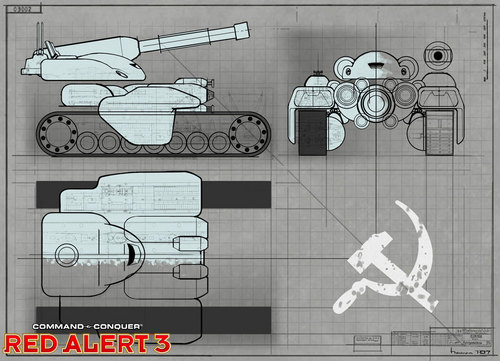
A symbol of the Soviet war machine, the Hammer Tank is one of the most autonomous components of the powerful military arsenal of the Soviet Union.
Like many discoveries throughout the annals of scientific history, the invention of the TS1 ‘Tsarsky’ Leech Ray was purely accidental. Scientists in Arkhangelsk, whilst researching magnetic harpoon technology for the Apocalypse project, were astonished to discover that concentrating the tractor beam and increasing its frequency enabled the device to literally reduce metallic objects to pieces (a discovery that nearly caused the collapse of Building 19). The resulting weapon conferred two significant advantages upon the already formidable Hammer. Firstly, by recalibrating the magnetic field, fragments of vehicle wreckage could be woven into the Hammer’s weakest sections of armour, effectively regenerating the armour’s strength in the midst of battle whilst the beam was active. Secondly, by increasing the amplitude at the moment of the vehicle’s destruction, entire weapons could be detached from the enemy vehicle with little damage to the weapon itself. Utilising advances in Soviet mass-production capabilities, Soviet engineers devised a multifunctional weapon interface mounted on the left-hand side of the Turret, allowing almost any weapon to be attached. Given its ability to simply pilfer armaments from almost any armed vehicle and to repair any damage sustained in battle, the Hammer’s sheer versatility sets it apart from other units in the Soviet arsenal.
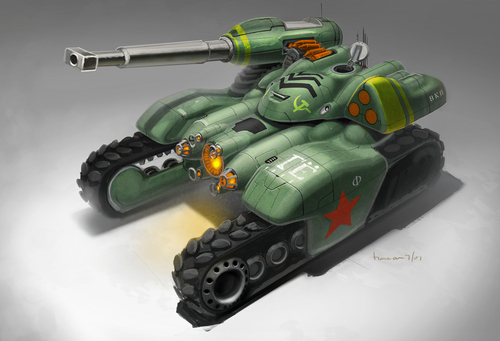
The Hammer’s remarkable Leech Ray enables it to remain fully operational on the battlefield during prolonged engagements, and to retrieve its crew in one piece.
Even with such an advanced weapon system, the Hammer Tank’s appearance is not as visually striking as that of other Soviet weapon systems, such as its big brother, the Apocalypse Tank. Nevertheless, the workers at Building 19 take great pride in their creations. They must realise that the Hammer Tank represents the heart of the Soviet military, and their calm determination during engagements is reflected in the final product, for which every Hammer crew is grateful. According to official sources, who have made no comment on the allegations concerning the few Hammer crews who have increasingly revealed their true nature – inhuman behaviour on the battlefield – perhaps as a result of using such a powerful weapon in combat.
 Reconnaissance on the battlefield has at least revealed the following facts about the Hammer Tanks:
Battle-Ready – The Hammer is a true main battle tank. Hammer crews are well protected from small arms and light artillery fire whilst destroying enemy vehicles. Hammer tanks offer an excellent balance of firepower and reasonably good speed at a low cost, now that the Soviets have streamlined their production.
Pound for pound – The Hammer’s 85-millimetre gun cannot effectively target smaller enemies such as infantry, and is, of course, incapable of engaging aircraft. This means that anti-tank infantry and aircraft pose a real threat to Hammer Tanks, forcing most commanders to deploy them alongside support units such as the Sickles and Bullfrogs. The Sickle, in particular, is a natural complement to the Hammer Tank.
Adaptable – The Leech Ray gives the Hammer Tank a degree of flexibility not found in other battle tanks. Whilst it naturally takes much longer than the main gun to destroy enemy vehicles, the deliberate use of the Leech Ray can enable the Hammer to gain anti-infantry or anti-air capabilities that it would otherwise lack. Furthermore, the ability to regenerate armour resistance whilst in combat has enabled skilled Soviet Hammer divisions to defeat many large enemy forces, simply by falling back behind the main battle line to utilise the ray’s significant range whilst undamaged vehicles fire in their place. The practice of mixing damaged tanks both outside and inside the line of fire became known as the ‘Barynya Battle’, with some divisions even going so far as to compose lyrics for a dance, most of which are unfit for print.
Ready to crush – Although the Hammer’s main gun is normally ill-suited against infantry, the tank is fast enough and heavy enough to simply crush smaller threats. As this is a rather gruesome method of defence, rumours that many Hammer crews relish this particular tactic are unlikely to be true.
ARMAMENT:
The Hammer Tank’s secondary weapon is the ‘leech’ beam. This weapon allows the tank to increase its power by ‘stealing’ the weapons of the enemy vehicle it attacks. It also enables it to regenerate.
This beam can be activated on all vehicles in the game and from different factions, but be warned: Harvesters do not provide the Hammer with any additional weapons, except for the Japanese Harvester in ‘Security Mode’ when it is equipped with its machine gun.
Here’s what you’d get if you destroyed an enemy Mirage Tank:

Here’s what you’ll get if you destroy a Japanese Mecha Tengu, an Allied Riptide ACV, a Soviet Sickle or the Japanese Harvester in ‘Mini-Gunner’ mode:

Here’s what you’ll get when you destroy an Enemy Assault Destroyer:

Here’s what you’ll get when you destroy a Striker-VX, Upgradable VCI:

Here’s what you’ll get when you destroy a King Oni:

Here’s what you’ll get when you destroy an Allied Guardian Tank, a Japanese Tsunami Tank or a Soviet Hammer Tank:

Here’s what you’ll get when you destroy a Soviet Apocalypse Tank or a Japanese Shogun Battleship:

Here’s what you’ll get when you destroy a Dreadnought or a Soviet V4 Rocket Launcher:

Here’s what you’ll get when you destroy a Bulfrog:

Here’s what you’ll get when you destroy a Stingray:

Here’s what you’ll get when you destroy an Aircraft Carrier:
