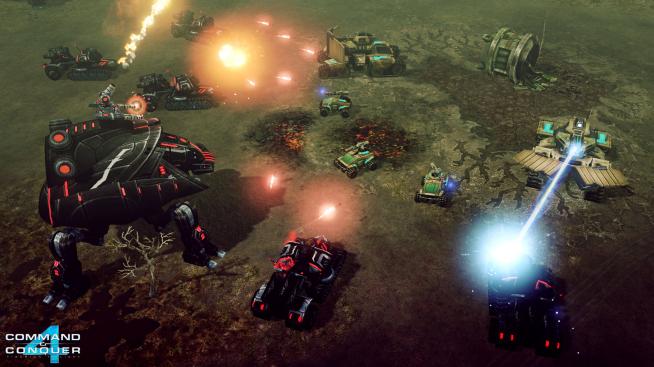
The Refractor
- Designation: AT-414 (Assault Tank)
- Affiliation: GDI
- Role: Heavy anti-tank
- Launch date: 2073
- Classes: Attack
- Armament: Heavy Ion Cannon
- Type: Heavy Tank
- Speed: Slow / Medium
Background
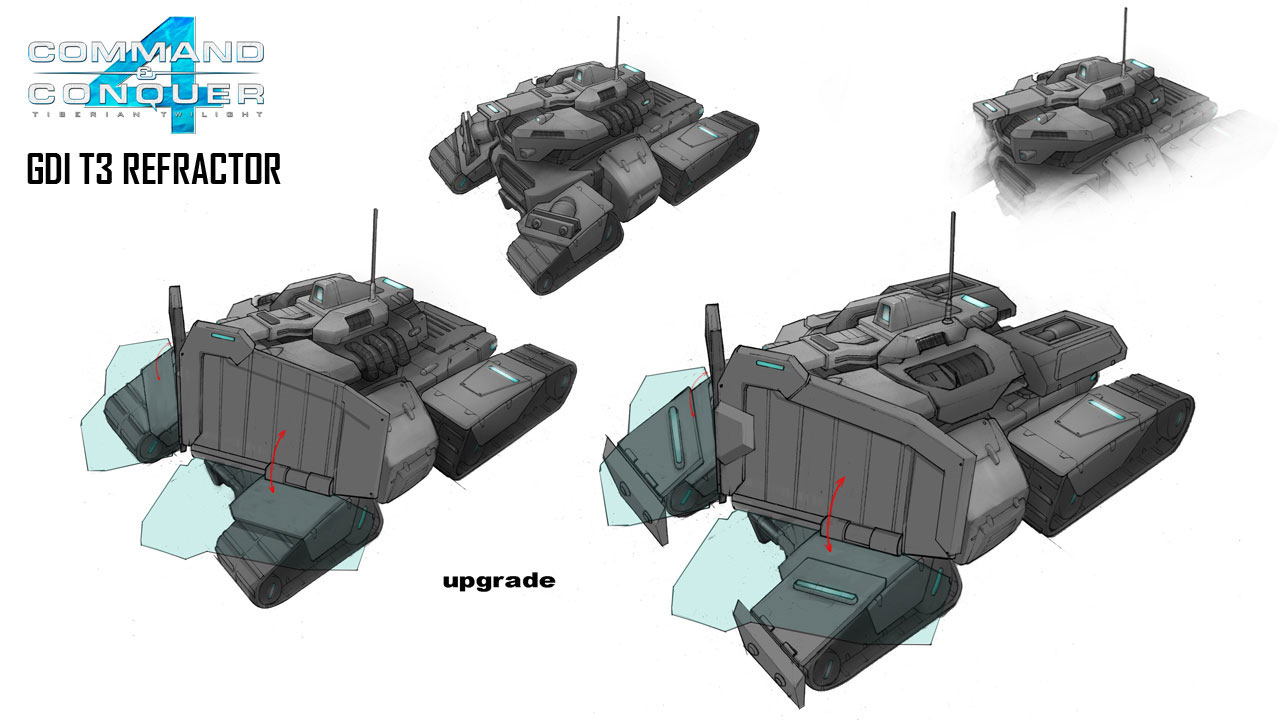
If there is one feature that distinguishes today’s battles from those of the previous Tiberium War, it is the ubiquity of beam weapons. Kane changed the battlefield forever when he deployed his terrifying Obelisk of Light during the first conflict between Nod and the GDI, but it took decades to develop power sources strong enough to support heavy weapons on mobile platforms. Beam weapons are particularly effective at penetrating thick armour, making them strategically crucial in a combat environment featuring heavy, slow and heavily armoured Crawlers.
GDI Central Command was forced to devise strategies centred on the Crawlers it had in the field. Despite its thick armour, it is very slow and was a prime target for Nod’s rapid attacks. Escorting them became crucial: the Crawler acted as a command ship within the fleet. Mammoth Tanks provided excellent firepower support, but remained vulnerable to laser weapons. The Refractor was developed to feature a shield specifically calibrated to counter heavy laser weapons. The new design also replaced the Mammoth’s twin cannons with a powerful shield and an Ion Cannon. For the first time, the GDI was able to deploy a heavy vehicle capable of withstanding an attack from the iconic Obelisk of Light without sustaining serious damage. The Refractor’s first baptism of fire was an immediate success.
Several Orcas were shot down during a severe dust storm whilst assaulting a Nod position at the Battle of Gerlach Flats, where the Refractor prototypes were initially deployed. The pilots found themselves trapped in zero visibility and bogged down within firing range of a line of Obelisks of Light. They were doomed to be buried alive if the storm persisted, or to be fried by the towers’ fearsome Laser Turrets if the storm abated and thus revealed their position. The commanders then decided to deploy four Refractors to form a wall, their armour shielding them from the Obelisks whilst the engineers extracted the pilots. The wind died down just as the engineers were finishing their work, revealing the position of the GDI extraction team. The Obelisks opened fire, but the Laser Turrets bounced off the Refractors’ shields back towards their sources. The Obelisks were destroyed, and the Refractors seized the opportunity. They lowered their shields and charged forward, firing from a distance at the Nod installations with the intense fire of their beams. The tide was turned, and the pilots were safely evacuated.
Since then, the Refractors have become the standard for any attack on a entrenched Nod position. They can be seen alongside Mammoths and Mastodons, as well as defending the Crawlers. Attempts have been made to apply this technology to smaller vehicles, but the weight of the shields has so far prevented any success. For the time being, the Refractor plays a unique role in the GDI arsenal.
Battlefield Specifications
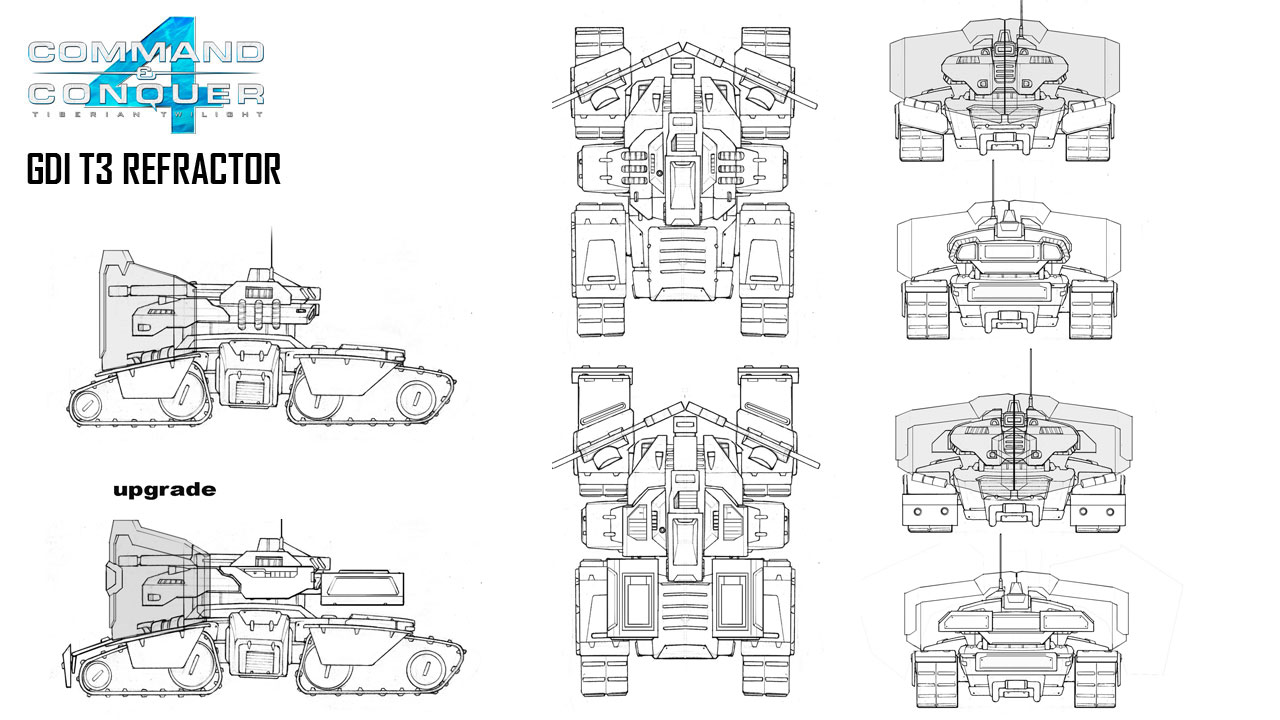
Beamed Down At the heart of every battle force is the Crawler, and the most dangerous threat to a Crawler is the anti-armour beam weapon, also known as an ion beam or Laser Turret. The Refractor is equipped with a single, high-powered laser capable of disintegrating key targets. Most often, they are deployed to blow up structures such as pillboxes or obelisks, as well as hostile Crawlers. Some Nod Crawlers are equipped with laser weapons, so the Refractor is the ideal choice for attacking them, closing in with its reflective shield before finishing off the target with concentrated ion beams. Refractors can also serve in an anti-aircraft role against Nod’s roaming Basilisks, with conflagration deflection forming part of their remit.Shields Up An iconic reflective shield, the Refractor is a marvel of engineering. It is constructed from several layers of material, each serving a different defensive purpose. The outer layer is a crystal supported by an electromagnetic field. Heavy weapons can penetrate the crystal layer, which is immediately reconstructed by the energy field, much like a pebble passing through water. This allows the shield’s reflective surface to remain effective even after repeated impacts from projectiles. The next layer is an alloy armour designed to withstand kinetic force and heat. Most conventional weapons simply bounce off this ultra-hard layer of armour. The final layer of the armour plate is 18 inches thick and made of a composite metal that absorbs everything else. This layer is extremely heavy, which is why the Refractor is built on a Mammoth chassis to support the weight.Mirror Coat
As Nod’s scientists never rest, the GDI must constantly improve its combat equipment. The Refractor’s armour plate can be fitted with a ‘mirror’ coating, an electromagnetic field that acts as a layer of plasma, magnetically fused to the Crystal Shield’s crystal plate. The coating requires immense power, so additional capacitors are provided to enable a temporary effect that allows the Refractor to deflect enemy fire for a short period, whilst the batteries recharge. In this state, the electromagnetic field can be manipulated by a targeting computer to split enemy Laser Turrets and redirect them at multiple targets. When the ‘mirror’ coating is active, a single Refractor can hold its own against numerous attackers, emerging from battle with very little damage.