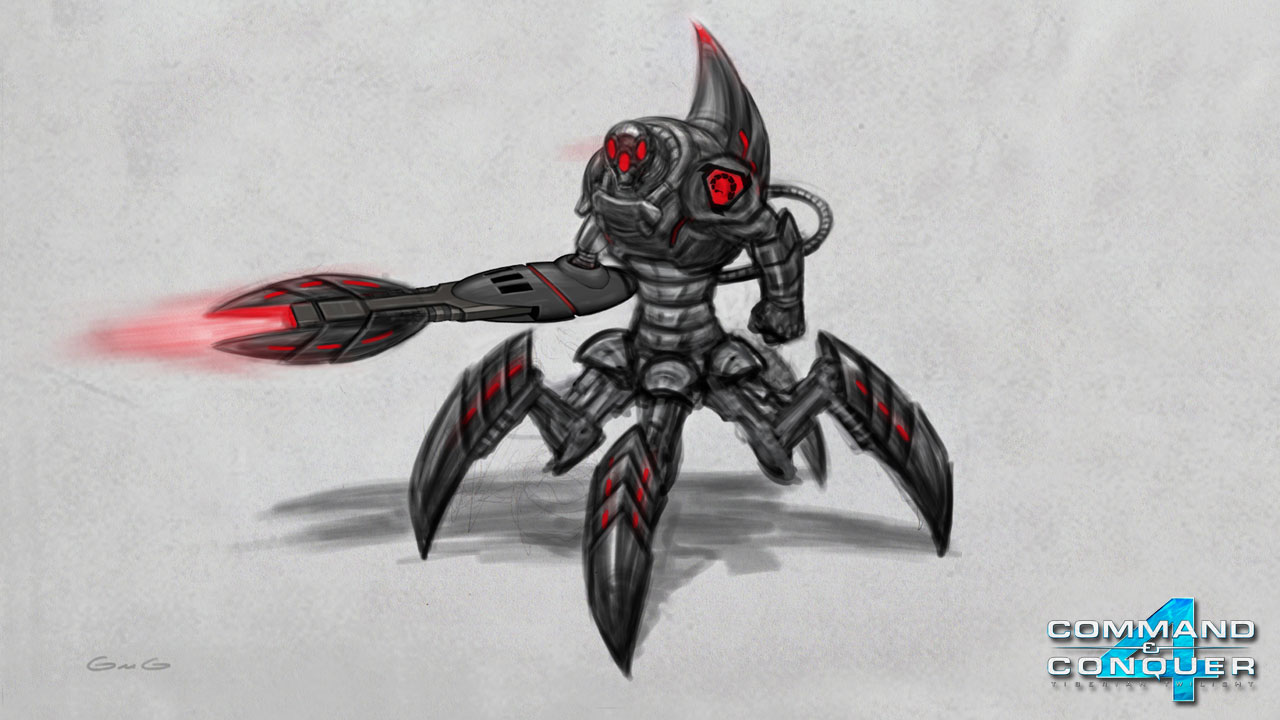
The Reaper
- Designation: Confidential
- Affiliation: Nod
- Role: Multi-purpose laser-armed walker
- Launch date: 2031
- Class: Defence
- Armament: Multi-Purpose Laser System
- Type: Walker (infantry)
- Speed: Medium
Background
Before the Hydra Mission conflict, the Reaper’s existence was nothing more than a rumour, the subject of gossip on the front line amongst GDI infantrymen. With only a few rather blurry reconnaissance photographs to go on-blurry enough to keep them sceptical-most believed the Reaper to be either a hoax or some new life form created by Tiberium. With the rise of CABAL’s power, these suspicions would be proven horribly wrong – the Reapers, revealed to be partly mutant, all-terrain walkers equipped with twin submunition missile cannons and an anti-personnel net launcher, were a key component of the psychopathic AI’s legions.
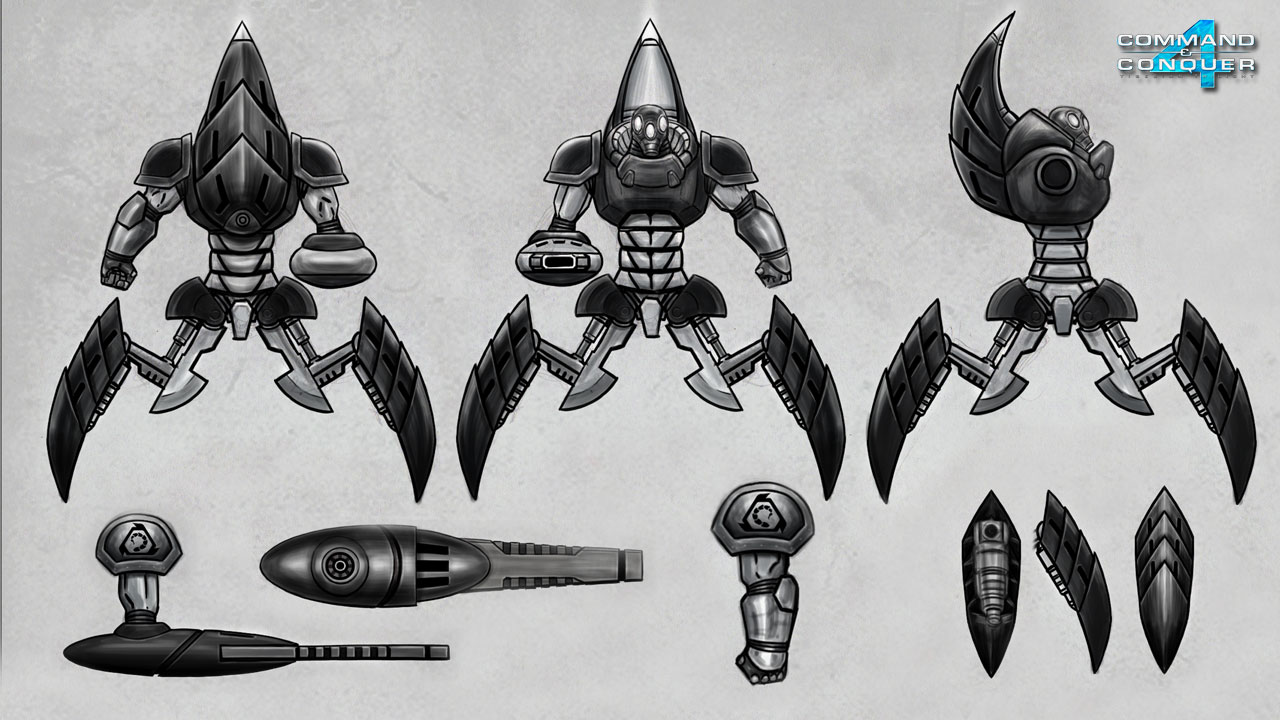
Nod’s early experiments with the concept of a semi-organic all-terrain walker resulted in the mental and physical damage of the ‘chosen’ Mutants; most were reduced to a state of incoherence, screaming in madness, whilst the few survivors were unable to control their additional limbs with any precision. The downside of the additional legs proved equally difficult to grasp, resulting in the test subjects crashing into walls whilst struggling with their own limbs, or simply crushing the test subject’s cerebral cortex. The ‘failed’ test subjects were transferred to the cybernetics division for further experimentation; it was, in fact, these experiments on dead mutants that first gave rise to rumours of Nod scientists attempting to resurrect the dead, repurposing the damaged corpses of mutants amongst the Marked of Kane.
It was only after CABAL had fully asserted itself, stripping the mutant ‘host’ of any semblance of free will, that the Reaper evolved from a disturbing cybernetic experiment into a potential game-changer on the battlefield. However, due to the heavy strain on CABAL’s resources required to produce the unit in significant numbers, the Reaper remained significantly underutilised during the conflicts following the Second Tiberium War. With both Nod and the GDI struggling to contain CABAL’s armies, field reports suggest that the AI still struggles to control large numbers of Reapers, due to the cybernetic mutants’ tendency to bump into one another, trample other units and simply get bogged down in difficult terrain.
Once reincarnated through LEGION and fused with the Tacitus, the AI gained the insight needed to resolve the issue, developing a biomechanical solution -drawn from data on biomechanical exoskeletons, notably the Annihilator Tripod, used by the Scrins in hostile environments-and eliminating the navigation issues faced by its predecessor. By combining this new technology with test subjects drawn from the ranks of the Marked of Kane experimental cyborgs, LEGION succeeded where its predecessor had failed and cemented the Reaper’s role as a formidable force on the battlefield.
Battlefield Specifications
As sharp as a blade The Reaper’s primary armament is the Multi-Target Laser System, or SLOM, a concentrated Beam Cannon linked directly to the unit’s enhanced cybernetic cerebral cortex, enabling instant acquisition – and subsequently, destruction – of multiple targets, even on a crowded battlefield. This system has proven particularly effective against large GDI combat vehicles, with the Reaper’s ability to target multiple weak points allowing the unit to literally slice through even the most robust tank in a matter of seconds.Regeneration
Reapers continuously monitor their physical condition via a range of nanosensors implanted directly into the nervous system. These sensors facilitate the immediate analysis and treatment of any battle injuries, with actual healing taking place at a molecular level, sealing damaged flesh and bypassing damaged cybernetic implants until they can be restored to working order. This has led to numerous accounts of damaged Reapers ‘resurrecting’ in a near-operational state, often to the detriment of those careless enough to be in the vicinity during the restoration process.