The Orca
- Designation: SA-1
- Affiliation: GDI
- Role: Multi-purpose vertical take-off and landing combat craft
- Launch date: 2064
- Class: Support
- Armament: "Comet" multi-purpose missiles
- Type: Medium-sized vessel
- Speed: Average
Background
“It’s not by taking down a Hunter or a Talon that you’ll really piss off the GDI. No, it’ll be when you’ve survived after the Orcas enter the Arena. Mate, those bloody ships will flush you out no matter where you’re hiding” – Unidentified Nod insurgent, 2066
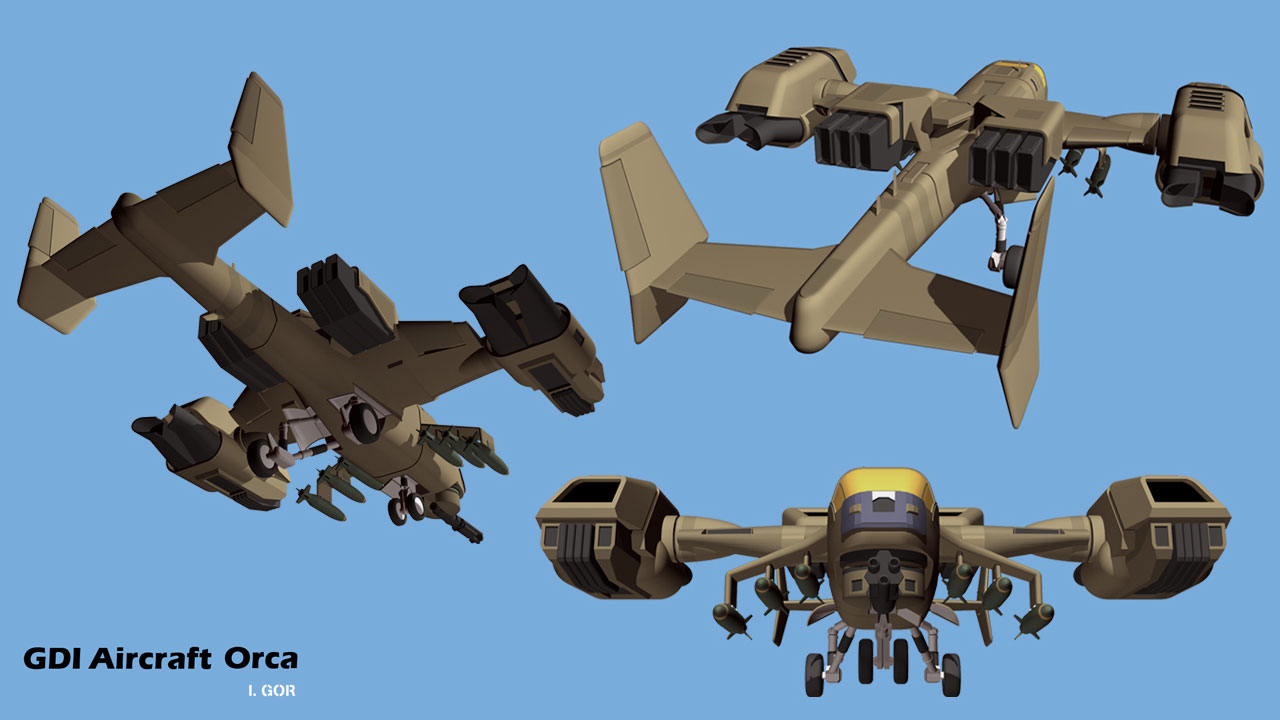
A mainstay of the GDI’s arsenal on the front line since the start of the First Tiberium War, few would argue that the legendary vertical take-off and landing Orca has evolved significantly over the years. Admittedly, there have been minor improvements to the fuselage, armaments and targeting systems over time, but with each new generation, the Orca’s role in lightning strikes and anti-armour operations has never really changed since the very first model; as the GDI could not conceive of any other useful functions for it.
Following the Third Tiberium War, however, several civilian members of the GDI Council came to view the Orca as an outdated relic. Even whilst the military remained loyal to the Orca, they found it increasingly difficult to justify its continued use, given that the aircraft’s performance was becoming increasingly questionable when compared to its Nod ‘predator’, the Venom.
Ignoring the wishes of their military leadership, the GDI Council launched the ‘Orca Innovation Project’, a secret initiative aimed at reinventing the Orca for the modern battlefield. Several years later – and an incalculable amount of credits – the final result was finally unveiled to a decidedly bewildered public.
The Orca Mk. IV was barely recognisable as a GDI combat vehicle, let alone what came with it: a massive, rather ugly, heavily armoured flying machine, packed with a host of useless features, the result of a complete lack of practicality and unfocused design talent. The army, needless to say, was far from enthusiastic, its growing discontent becoming increasingly pronounced after every costly mechanical breakdown and botched combat exercise.
In the end, the generals made their position clear – the Mk. IV had not worked, and the army would not use it.
The repercussions were, needless to say, significant; the Orca Mk. IV project was scrapped, at great expense, its designers dismissed, and the GDI Army’s R&D department was charged with rapidly developing a suitable replacement, prematurely dubbed the Orca Mk. V. As might be expected, the new generation of Orca proved, the following year, to be an aircraft designed with a significantly more conservative form, proudly displaying its legendary heritage in both form and function. Tests from the archives relating to the Mk. IV proved useful in making the Mk. V a perfect aircraft. The addition of more powerful dorsal engines increased its flight duration, whilst wing-mounted boosters provided improved vertical take-off and landing capabilities, giving it a more imposing appearance than previous generations. The rockets near the nose of the aircraft and a frame strong enough to carry additional weight led to the Orca being reclassified from a light reconnaissance aircraft to a medium attack aircraft.
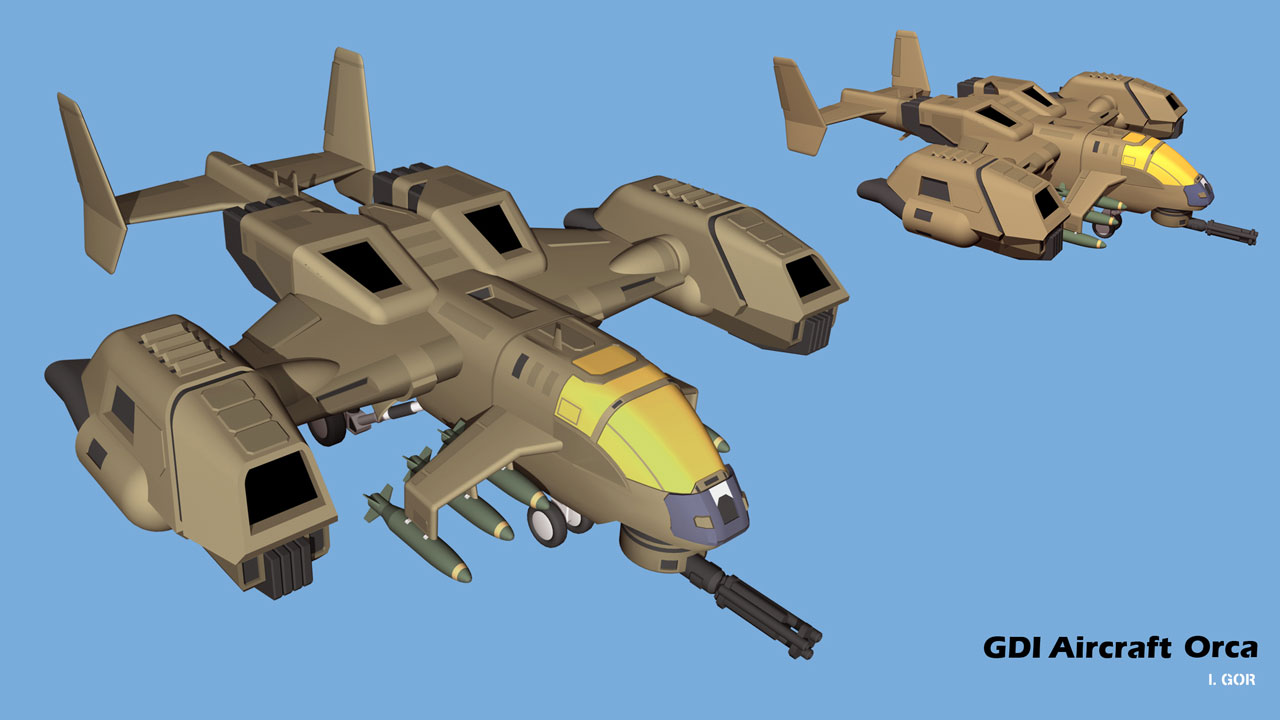
Following a series of highly successful combat trials, the Mk. V entered active service in 2064. The army was appeased, the GDI Council suitably chastised, and the Orca resumed its rightful place on the front lines of battle.
Battlefield Specifications
A Classic Revisited At first glance, the Orca Mk. V is remarkably similar to its predecessors – a sleek, agile aircraft that combines the manoeuvrability and reinforced armour of its larger cousin, the Hammerhead, with the rapid battlefield traversal capabilities of a more traditional fixed-wing aircraft. Under the bonnet, however, the improvements have been significant; notably, an enhanced vector control system for the vertical take-off and landing system, allowing the Orca to move in reverse, albeit slightly more slowly than forwards.Doctrine of Flexibility The Orca’s most significant improvements have been to its weapon systems – whilst it still utilises its traditional rocket Barrage, the Mk. V is significantly more flexible in how it deploys them. Firstly, many would argue that this is a deliberate response to those who claim that Nod’s Venom was by far the most capable aircraft; the Orca’s improved targeting system is now capable of engaging in aerial combat. Since a self-guided rocket is not the most effective way to win an air-to-air combat engagement, the Mk. V is equipped with new multi-purpose ‘Comet’ missiles, designed specifically to destroy aircraft, but also fully capable of launching Desolator salvos against ground targets.First Impressions Are Always Crucial
The second major modification to the Orca’s weapon system is the addition of a firing mechanism; upon engaging an enemy, the Orca will launch its entire missile load at a selected target. However, the autoloader that transfers additional ammunition from the storage bay in the fuselage to the missile launchers on the wings is a slow and complex mechanism, so the rockets are fired individually after the first salvo has been launched. Pilots are trained to move to a safe distance from the target until their launch rails are fully reloaded, but many experienced pilots will remain within range to finish off a damaged target before the detonation.