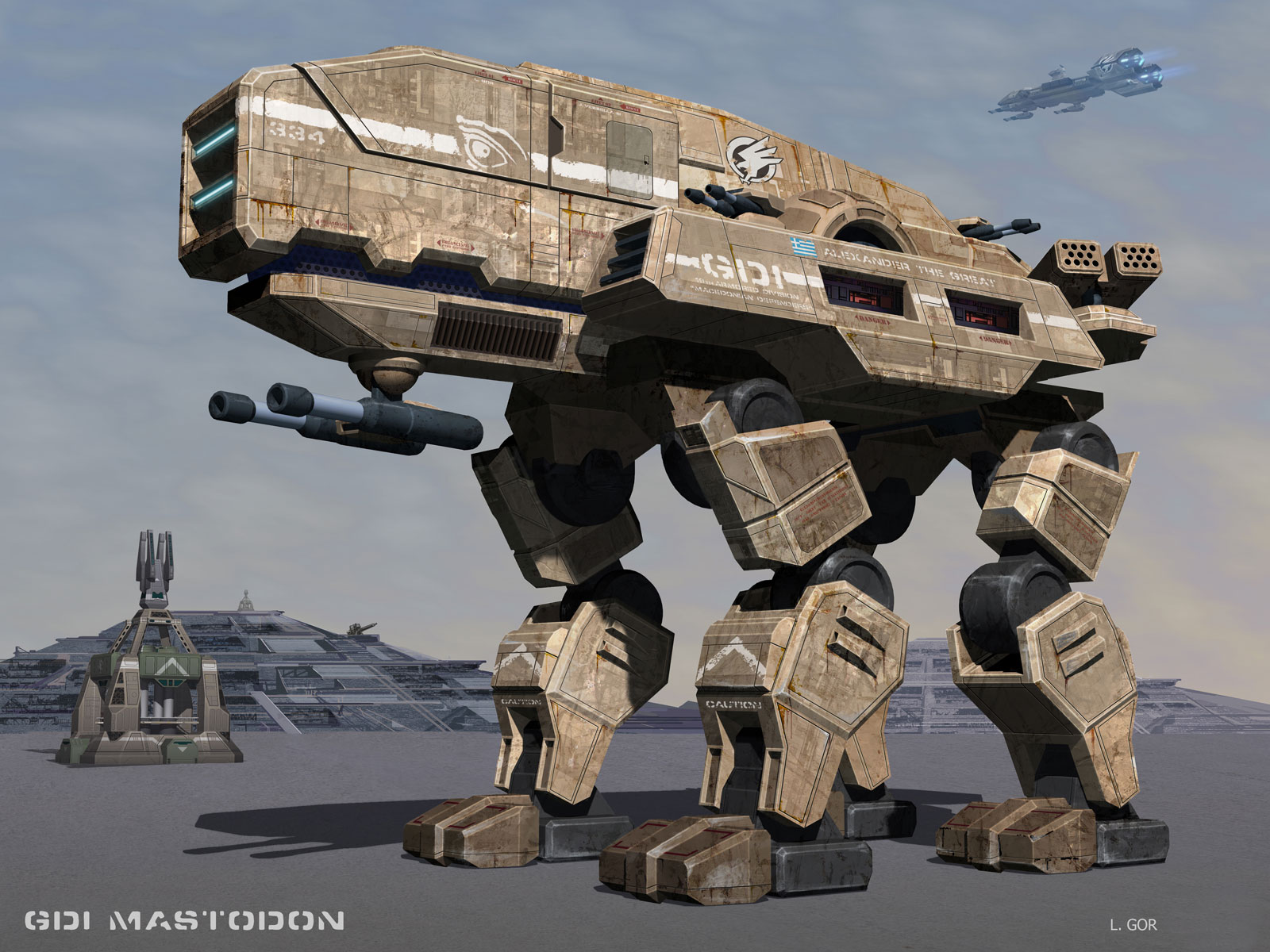
The Mastodon
- Designation: AW-12
- Affiliation: GDI
- Role: All-Terrain Base Assault Platform
- Launch date: 2069
- Classes: Attack
- Armament: ‘Tusk’ Artillery Battery, Twin Scorpion Rockets, ‘Depth Charge’ Emergency Ejection System (Upgrade)
- Type: Heavy quadruped walker
- Speed: Slow
Background
During the Second Tiberium War, the Mammoth Mk. II was for a long time the dominant force on the battlefield, capable of defeating any opposition from Nod with its automatic cannons, multiple Scorpion Rockets and experimental Disruptors. However, the Mammoth Mk. II’s dominance came at a price. Indeed, the vehicle’s development and production costs were extremely high. Field trials conducted during the Second Tiberium War showed that, whilst effective, the Mk. II was an unreliable beast, requiring extensive maintenance on a regular basis, and only realising its full potential as an escort unit. After the war, the GDI High Command halted production of the walker, claiming that with Kane’s death and the annihilation of Nod, the ‘absurd’ amount of money spent on weapons development would be better spent on Tiberium containment programmes.
Following the global carnage of the Third Tiberium War, pro-military elements within the GDI Council repeatedly argued that had the Mk. II remained in service, the GDI would have achieved a swifter victory during the counter-invasion against the Scrin. These ‘hawks’, as they were known, believed that preparing for an inevitable future Scrin invasion should be the GDI’s primary concern. Although attempts were made to resurrect the Mk. II, most of the military funds had already been spent on the Tiberium Containment Programme and would ultimately be channelled into the Tiberium Control Network.
Many years later, with the construction of the TCNs underway, the hawks were finally satisfied, as the GDI Council voted to significantly increase the military budget. However, as the army finalised its plans, it became clear that there was a divide between those who wanted to develop a new generation of traditionally shaped Mammoth Tanks, similar to the Mk. I and III, and those who favoured something in the spirit of the Mk. II. This debate became so heated that some generals almost came to blows, forcing the GDI Council to intervene. To satisfy both sides – and believing that all options should be considered in the face of the Scrins’ vastly superior technology – the Council decided to pursue both options in parallel.
The GDI combined the technology of the Mk. II walker with innovations that Kane had gleaned from the Tacitus, and formally unveiled the new generation of walker in 2069: the Mastodon. When the first Mastodon rolled out of the San Pedro war factory, Colonel Nick “Havoc” Parker, a retired war hero, simply remarked, “You bloody bureaucrats, it’s about time!”
Battlefield Specifications
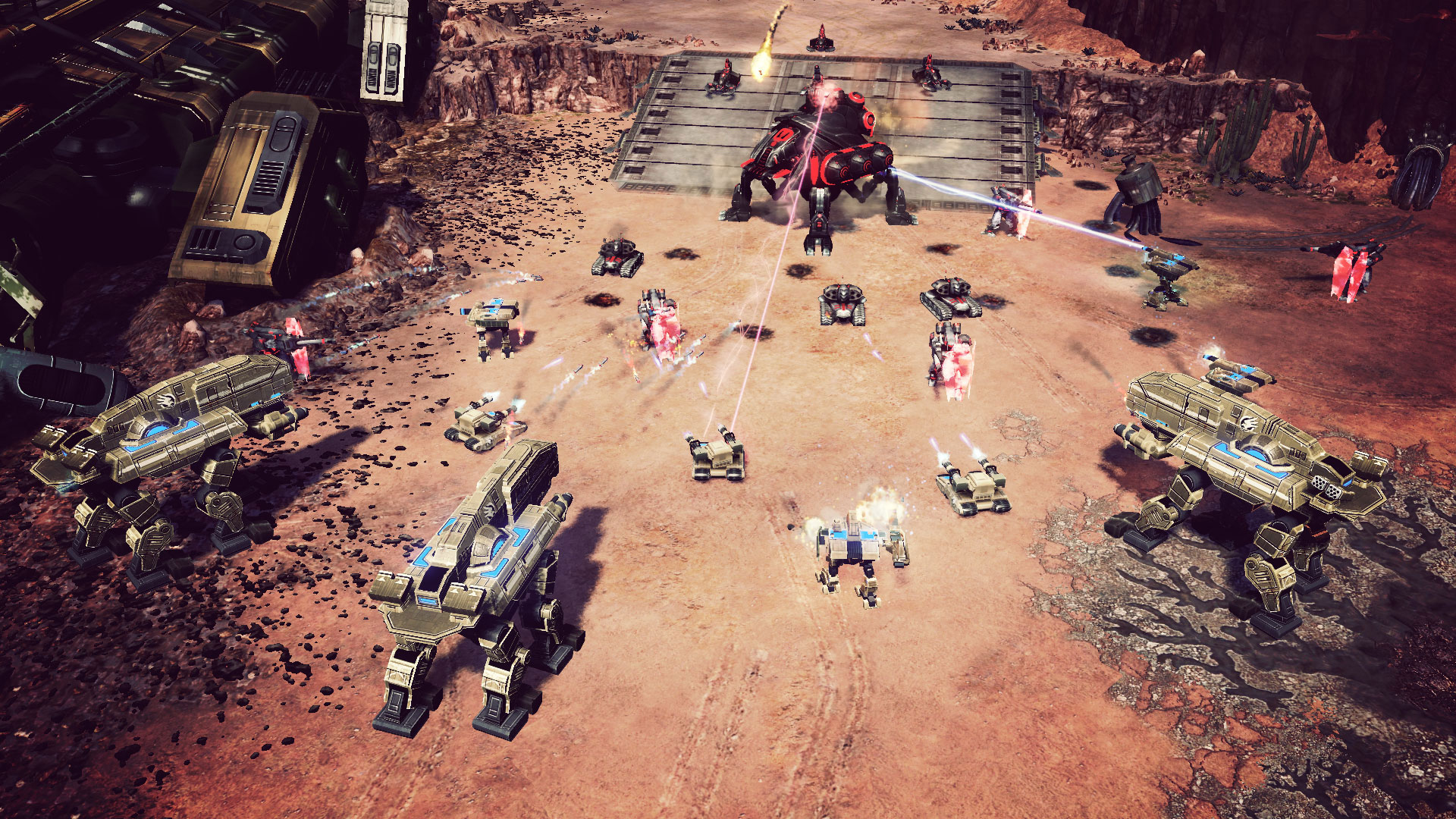
The Rebirth of the Mk. II The Mastodon is the reincarnation of the mighty Mammoth Mk. II from the Second Tiberium War. Thanks to a redesign of the Mk. II and technological advances, the Mastodon is considerably cheaper to build and maintain than its predecessor, allowing it to be deployed in groups. These groups, affectionately known as ‘herds’, have been deployed to the front line to fight Gideon and his Separatist forces. The Mastodons are the supreme ground weapon in the GDI’s arsenal, and to reflect their status and power, each Mastodon is named after a great conqueror from history.Armed to the Teeth Unlike many recent GDI units, the Mastodon is not designed to defend the TCN, but to destroy any opposition to the GDI. The ‘Tusk’ Artillery Battery is the Mastodon’s primary weapon; when fired, the battery launches four artillery shells along its line of attack, decimating not only the intended target but also all enemy units within its line of fire. The Mastodon also has two Scorpion Rockets, mounted on its back, to protect it from air attacks. Although the Mastodon has deliberately dispensed with the Mk. II Disruptor in favour of the cheaper ‘Tusk’ battery, some commanders believe that the ability to deploy numerous Mastodons simultaneously on the battlefield, thanks to the reduced production costs, makes up for the difference.Up Close and Personal Mastodons are frequently deployed in groups to provide overlapping fire on the battlefield, as the Tusk battery can only engage frontal targets. Despite this precaution, some Mastodons may find themselves isolated and are vulnerable to being overrun by fast-moving enemy units that can manoeuvre outside the Mastodon’s limited range of action. GDI engineers have analysed the problem and have recently begun equipping Mastodons with the ‘Depth Charge’ emergency ejection system to enable the Mastodon to deal with this sort of situation. When activated, this system ejects several explosive shells stored on the Mastodon’s flanks; these ‘Depth Charges’ are powerful enough to inflict massive damage on nearby enemy units, but the blast from these shells is mild enough to bounce off the Mastodon’s heavy leg armour.
This system has proven highly effective in increasing the chances of survival, but most Mastodons require an upgrade to carry this equipment.The Harder the Fall...
The Mammoth Mk. II was fitted with an experimental self-repair system to help it stay in good working order. Recently, GDI engineers have reworked this old concept and adopted Nod’s Nano Tech repair module to create the Mastodon Backup Systems. The backup module will activate when the system is in critical mode and will begin to slowly repair the damaged Mastodon, providing enough time to rewire and repair failed systems, allowing the Mastodon’s hull to be got back on its feet without the help of an Engineer.