Community Summit 08
In mid-May, I received an email from Aaron Apoc Kaufman inviting me to take part, for the third year running, in the Command & Conquer Community Summit, which this year is dedicated to Red Alert 3. As usual, the Community Summit is taking place in Los Angeles and brings together around 15–20 webmasters from all over the world.
 The Community Summit is a key event of the year for our site, as it allows us to bring you accurate information and insights about the game, as well as to pass on both your positive feedback and your criticisms. For me, as a fan first and foremost, it’s – as you can imagine – a truly joyful occasion where, even though we’re absolutely knackered (after a journey of over 15 hours), we keep our eyes wide open.
And this year, we certainly weren’t disappointed!
Wednesday 11 June 2008:
Whilst France is paralysed by strikes – as it is every time on the eve of the Community Summit (you’d think it was part of the festivities) – I met up with my friend Jérôme at Roisy to set off on our long journey to Los Angeles. First, an 8-hour flight to New York, then immigration checks on American soil. The customs officer was surprised that we were only going to LA for a 3-day holiday and that my last trip, less than 6 months ago, had also been for 3 days. A few hours’ wait, and finally a 6-hour flight from New York to Los Angeles that ended up taking 7 hours. I don’t want to be critical, but I think American airlines struggle to stick to their timetables: for the Community Summits, I’ve taken 12 flights with American airlines; they all arrived at least an hour late (up to a day late).
Once in Los Angeles, we rushed to collect our bags and took a taxi to the Ritz-Carlton Hotel Marina del Rey, the five-star hotel where EA Los Angeles puts us up every year. We arrived at 6.30 pm (which was 3.30 am in France), just in time to meet up with the group, who were about to head off for dinner at a restaurant in Venice Beach called ‘The Terrasse’. We got into the Apoc Mobile with Apoc and Twopoc.
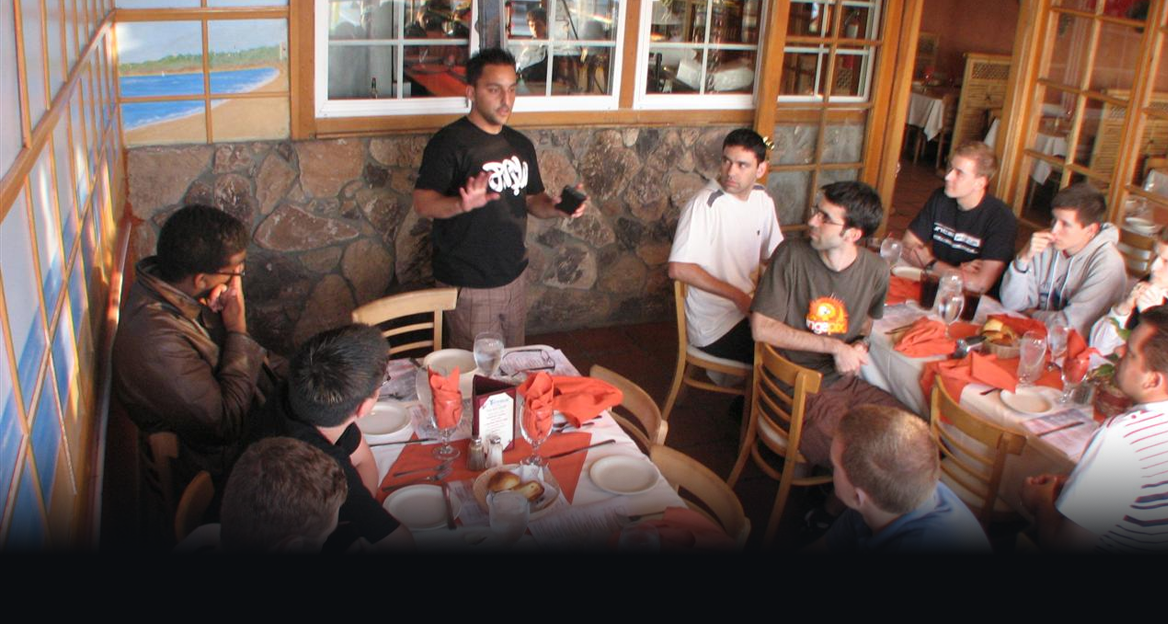 It’s a lovely evening, even though we’re exhausted. Aaron introduced us to the other participants (I met up with John from CnCFiles and Tim from PlanetCnC) and also outlined the programme for the next two evenings.
We headed back to the hotel for a long night’s sleep. It feels good to sleep, but at the same time, my brain isn’t quite in Los Angeles yet and doesn’t quite understand why it should be sleeping in the middle of the afternoon (Paris time); so I wake up and pace up and down the room, which eventually wakes poor Jérôme.
Thursday 12 June 2008:
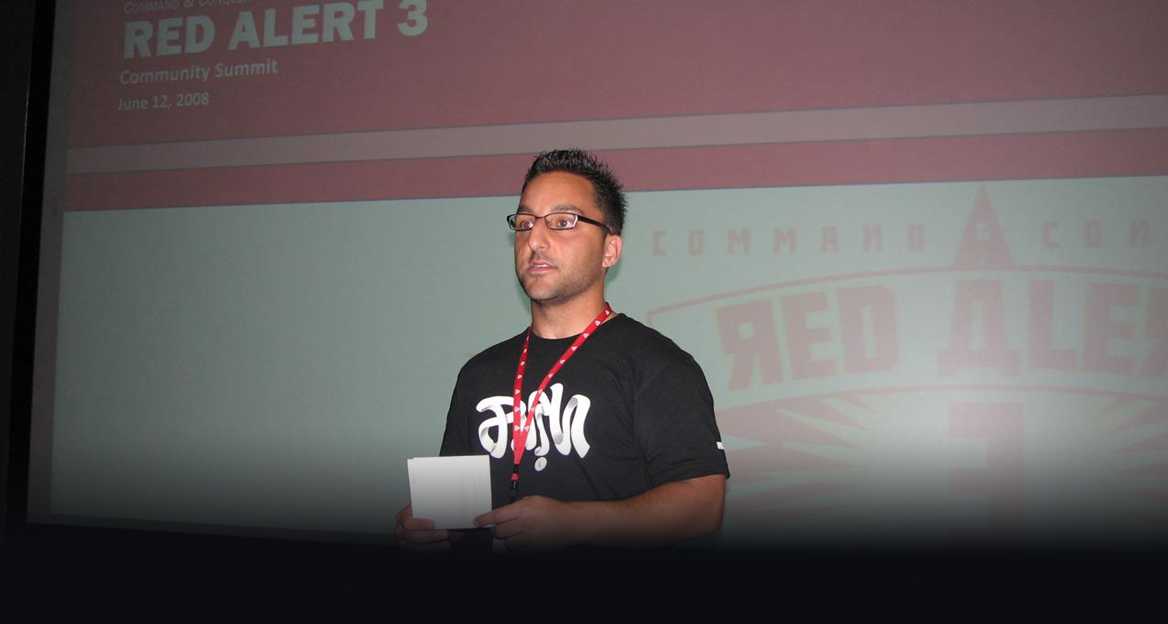
We head down to the hotel lobby to wait for Aaron. As the meeting time approaches, the webmasters arrive, followed by Aaron… late… as always. We set off for EA Los Angeles by taxi. On the way to the studio, we come across the Olympic torch – or rather, a fake Olympic torch: here too, some people are protesting against the Games in China.
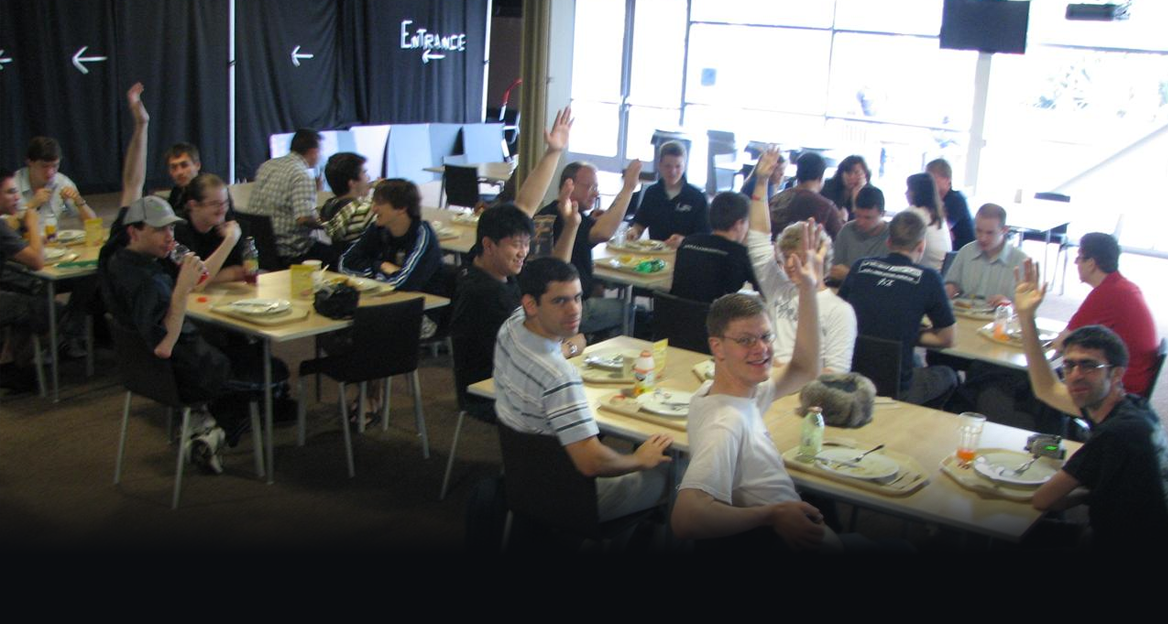 We have breakfast in the studio canteen and the ‘real’ fans all go for a burrito.
The Fundamentals
Throughout the morning, the presentations follow one after another. First of all, Chris Corry reminds us of the fundamentals of the Red Alert series: light-hearted, fun, engaging gameplay with a ‘popcorn’ story, and of CnC: Fast, Fluid & Fun.
He outlines the game’s highlights: 60 minutes of HD footage, a new faction, a co-op campaign, and the navy.
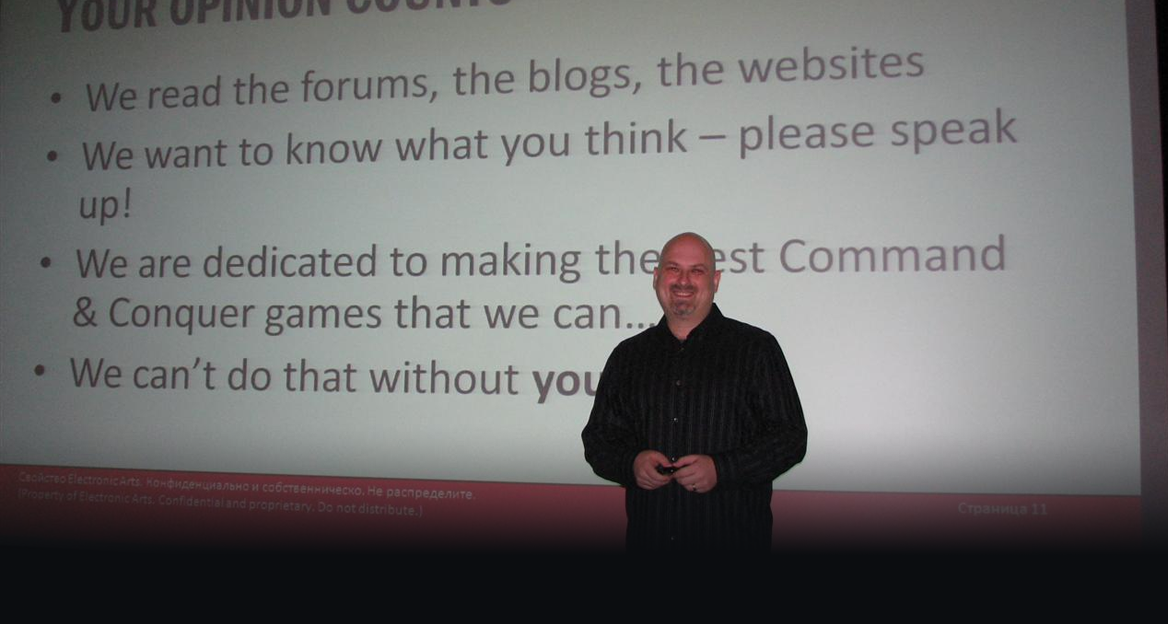 The single-player aspect of the game wasn’t covered in great detail during this Community Summit: we didn’t see any in-game cutscenes, just one mission. But Chris Corry briefly reminded us that this will be a key feature of the game. You’ll be able to play either with a friend or with one of three Generals of your choice. You won’t have access to all of them at the start of the campaign, but you’ll unlock them by completing bonus objectives.
Chris gave us a detailed overview of the resource-gathering system, which differs significantly from other games in the series but fits well with this instalment, followed by the naval system with its numerous amphibious units and bases on the water.
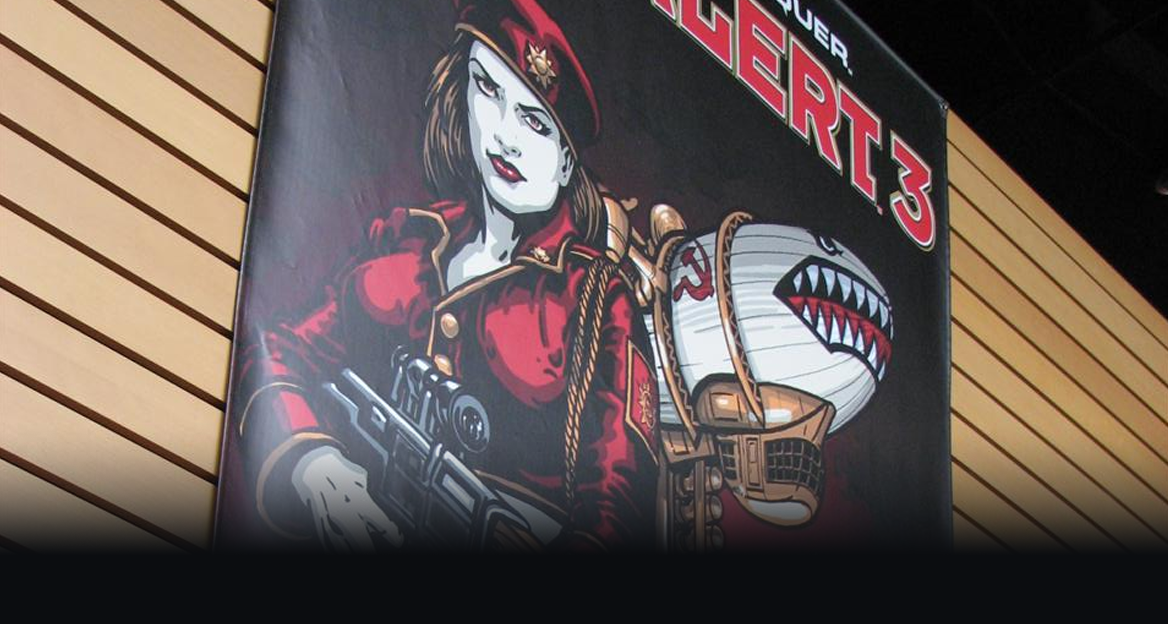 He concludes his presentation by emphasising the importance he places on the webmaster community in feeding back fans’ wishes and the issues they’ve encountered.
The Japanese faction
In a second presentation, Matt shows us how the Japanese faction was created. We’ll return to this presentation in mid-July, as it – like all information concerning Japan and gameplay – is currently under embargo.
The Game Units
Greg Black then presents a large number of the units and vessels from the three factions.
For the Allies: the Dolphin, which can leap out of the water as a secondary ability to avoid electric shocks and other naval weapons; the Troop Crawler; and the cryocopter, which freezes enemy units and structures (they aren’t destroyed but are weakened and immobilised for a certain period / the freezing process also takes time) and which reduces the size of units as a secondary ability (the Apocalypse then looks like a remote-controlled toy and, what’s more, its voice is altered – it speaks in an incomprehensible and very fast-paced manner: really funny); the dog that can bark (useful for getting the better of a bear); the Peacekeeper and his shield; the VCI, which adapts to the unit carrying it, just like in AR2; the Allied Harvester, which can become an expansion point to deploy buildings far from the base; the Spy and his abilities, such as taking on the appearance of another unit, cutting off power, stealing technologies… and the ground transport that can also travel on water.
For the Soviets: the Kirov, which can accelerate ‘against life’; the Twinblade helicopter, which can transport most vehicles; the Hammer tank, which can take weapons from other vehicles in the same way as the GLA’s jeep; the V4 and its two shots; the Tesla Tank, available only in solo mode; the Tesla boat and its water-based discharges; the Dreadnought, which can fire faster at the cost of health; the Submarine, which can surface; the Soviet crane (building), which allows the Soviets to have a second construction line but which also repairs vehicles or destroys them for money (in the same way as the Grinder); and the Soviet super Power Plant, which unlocks a new technology level.
Finally, Greg introduces us to Japanese units and structures, as well as a few civilian structures such as the hospital, the workshop, the Radar Tower, etc...
Without going into further detail about the gameplay – we’ll be discussing that soon and will publish the full list of units and structures – I can tell you that the three factions differ in their construction systems and their technology trees.
The Allies build in the style of CnC: you select a building; once constructed, you place it on the map within an area of influence. For the Soviets, you place the building within an area of influence, and it deploys gradually as the construction time elapses. For the Japanese, the system is even more different…
As for technologies, the Soviets have two technology buildings: the Advanced Power Plant and the Technology Centre, which grant access to advanced units as soon as they are deployed. The Allies have a single technology building but must upgrade their Construction Centre twice, and only production structures dependent on this VCM gain access to advanced units. Finally, here too, the Japanese have a different system.
The Maps
In a third presentation, we were told about the game’s maps. They are more colourful, ‘cleaner’ and less detailed than those in Command & Conquer 3. We were then shown the European map (the Moscow demo), Mykolos (Greece), Sevena (with its banks), Easter Island, the Japanese Fortress and Leningrad.
There will be rain and snow in the game, but these will not affect gameplay, and the weather will remain the same throughout the match.
Interface
During the presentation on the interface, we see the second ability button (star in the bottom right-hand corner) which, depending on its colour, indicates the type of special ability (green, orange or red); a small wave on the unit’s icon indicates that it can move on land and water. Finally, we’re introduced to the power system: every time you destroy a unit or one of your units is destroyed, you earn points that allow you to purchase powers (3 columns of 5 levels) which you can use for free. This system is similar to that in Generals, with the difference that 1) you earn points by losing units and by expanding, and 2) you earn more points by losing units: the aim being to enable comebacks.
There are virtually no upgrades: only a few via the powers and those for the allied construction centre.
Finally, the radar is accurate and remains active at all times from the start of the game, even during power cuts (the fog of war is also present). However, you can ask Engineers to capture a civilian structure located within the fog of war.
Tours
We then visit the third floor, home to the Red Alert 3 and Tiberium teams, where we see numerous concept art pieces (we are unable to enter the area where the Tiberium team is based), followed by the Command & Conquer TV studio (see the report from the Kane’s Fury community summit).
Skirmishes
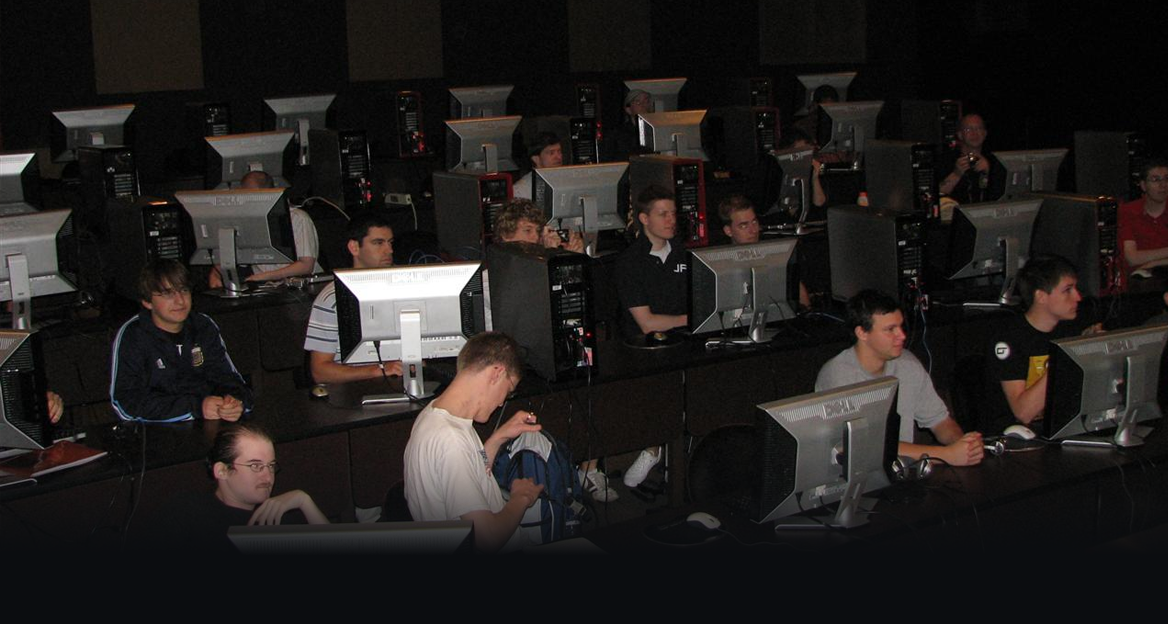 During the lunch break, we can play skirmishes with the three factions on one of the two maps on offer.
Other presentations
During the afternoon, Greg Kasavin talks to us about unit animations and voice acting in “Units are the Stars”.
We are then treated to a presentation on the music for Red Alert 3, which will range from traditional Japanese music to nu metal. There are four composers: Tim Wynn (TV series and EA’s Harry Potter games), James Hannigan for the Japanese faction, Mikael Sandgren (Generals and Kane’s Fury) and Frank Klepacki for the two main themes.
The music is linked to the game engine: there will be tracks for the exploration/construction phases – orchestral music – and for the combat phases – rock, energetic and faction-specific.
Japan: Techno-based – “J’Rock”; Soviets: dark, nu metal; Allies: not yet revealed.
The combat music will follow the action: fight, defeat or triumph, and the single-player campaign will feature additional tracks to match the story.
Evan T. Chen shows us how he created the unit sounds by mixing sounds with a vocoder.
Red Knight Party!
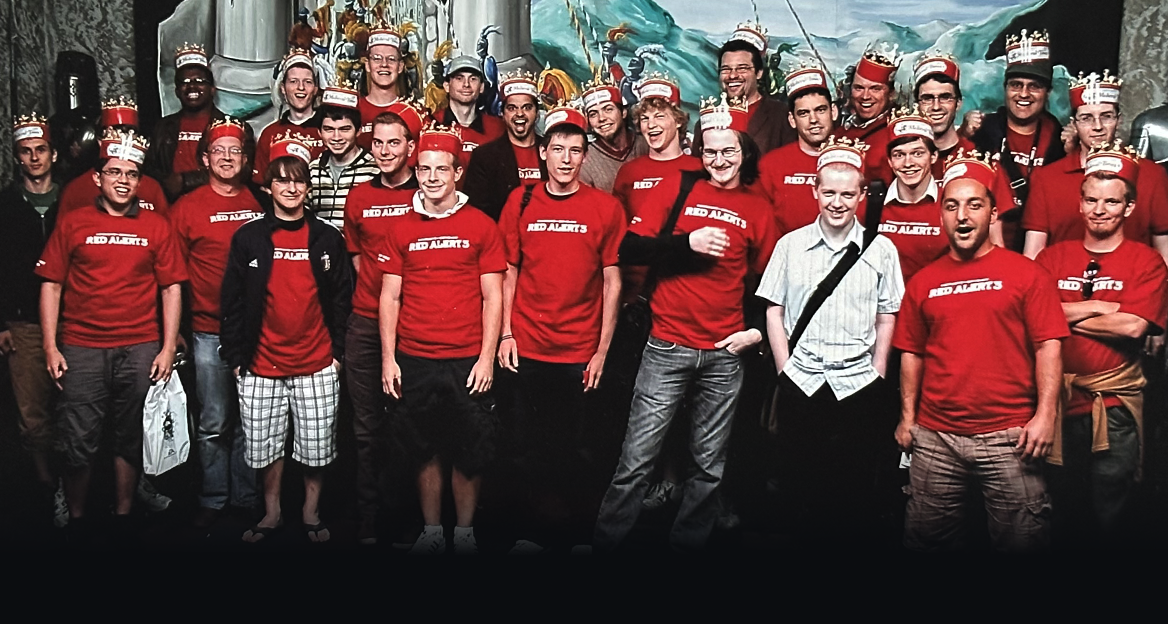
The day ends with a knights’ show (no connection to Red Alert 3). Aaron hands out Red Alert 3 T-shirts and we set off by coach to a venue half an hour’s drive from the studio for a medieval-themed dinner and equestrian show, where six knights do battle (I’ll spare you the plot). Naturally, we were cheering on our knight: the Red Knight! It was a very lively evening, thanks in particular to David Silverman. Friday 13 June: On this final day, we were given the chance to have our voices featured in the game. We went in groups of four, and each of us had to do three voices of a dying Soldier, three bear noises, and read out three times a line spoken by a captured Russian Soldier. The best performance will be included in the game, and you can support Jérôme by voting for him on Red Alert Idiol (I went on at the start before the CnCTV camera arrived, but anyway, my performance wasn’t exactly brilliant ;) ).
SAGE – Super Amazing Great Experience audio:
During this presentation, we saw how an engine like SAGE could effectively handle the game’s audio. We were treated to a comparison between the SAGE engine for BFME2 (and a bit of CnC3 and AR3) and that of Age of Empires 3. The SAGE engine doesn’t constantly repeat the same unit sounds and voices; it adapts the sounds to the situation and takes into account the number of units, unit types and the surrounding space. In BFME2, a formation manages (in terms of sound) clicking on a unit; the unit running to attack; retreating; returning to the fortress; being attacked; being bombarded; the presence of a hero; a change in formation; the depth of the area in which it is located; the number and type of units comprising it; the presence of horses and their number; etc. This is the complete opposite of Age of Empires 3, where it is always the same phrase spoken in the same way.
New website CommandandConquer.com
In this presentation, the website team gave us an overview of the current site and what they wanted to do for the new website for the CnC franchise.
The current site is dedicated to CnC3 and Kane’s Wrath; it features news, media and statistics; it is developed and hosted by Gamespy; the text content is provided by EALA; certain features are managed by other EA services, such as the forum.
It is difficult to add new features and new games. It has usability issues, performance problems and does not offer any exportable content.
They want a website for CnC3 and future CnC games by EALA; with a single player account for all CnC titles; a bridge between the game team and the community. The site will be managed entirely by the game team. There will be a system for comments, voting, tags and exporting content for websites and blogs.
They want the user account to allow users to manage a blog, a friends list, groups (personal ladder) and teams (teams of two for 2v2 rankings). They want to integrate the forum (at a later stage) and they want to allow the export of personal account data.
 They want transparency between in-game personas and accounts (they will consider the issues faced by players who are too good, against whom nobody wants to play – a problem raised during the summit).
In future, they want to create a system for searching for players by criteria: CnC Love Connection: by time zone, age, level, play style, etc...
August: new website for CnC3 and Kane’s Fury. October: addition of Red Alert 3. The forum will be linked as soon as they’ve found a way to manage moderation themselves. It may be possible to export statistics.
Red Alert 3 will still be linked to GameSpy, but the game’s team wants to gradually take full control of the multiplayer and online features. This will be done in stages. So perhaps an EALA multiplayer mode for the next CnC.
PC and consoles:
CnC is available on PC and Xbox 360. It will be released on PS3 in the near future. There are no plans for a Wii version at the moment, but Chris Corry really believes it will happen. There will be no PC versus console battles in the near future.
World Builder:
The World Builder is evolving with Red Alert 3. The terrain system has been simplified: there are only four height levels – very binary: ocean trenches, water level, land and high ground. The system for applying textures between two levels is very straightforward. Texturing in general has been greatly simplified, as has the rendering of water.
Mappers will also be able to very easily create a terrain image in Photoshop, which they can then import into World Builder.
They want to avoid the development tool issues that arose with Kane’s Fury and would like to release the Red Alert 3 Mod SDK at the same time as the game.
Tournament, Review and Fan Presentations:
During the afternoon, we held a multiplayer knockout tournament with single-elimination matches; I won my first two matches but was eventually knocked out in the third round by the eventual tournament winner, who turned out to be an excellent player.
Command & Conquer TV filmed the Apoc corner during the tournament.
During the tournament, I rediscover the red button, and Greg Black explains how it works: when the game starts to slip away, the red button appears above the power progress bar. If you click it, you can no longer build new structures and your existing structures begin to self-destruct. This destruction lasts for two minutes (with no timer displayed). During this time, you can produce units more quickly and your powers regenerate faster; you must attack and go all out to destroy your opponent, because once the two minutes are up, all your buildings will be destroyed and you will have lost. Your opponent, meanwhile, gains the removal of the fog of war.
Red Alert Summary
- The red alert button (in Russian) appears as soon as you start to ‘lose’;
- it disappears again if you regain control without having clicked on it;
- you are free to click on it or not;
- you can no longer build or repair buildings, which are gradually being destroyed;
- you can build units more easily and quickly;
- your powers recharge faster;
- you have roughly 2 to 5 minutes (I’d say 2 minutes) with no indication of the time remaining other than the health bar on your structures;
- your opponent’s fog of war lifts;
- they will win automatically if you do not destroy them completely before the end.
We then review the event; everyone takes turns giving their opinion on the game and we sign the non-disclosure agreements.
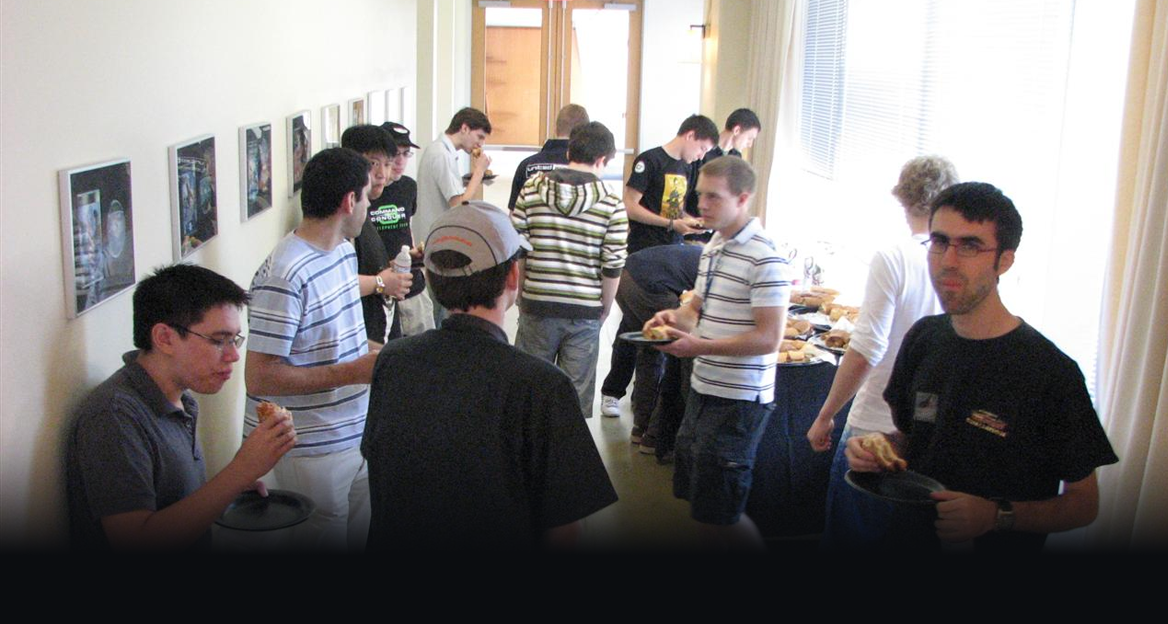 The day ends with the Community showcase, where four fans show the development team their creations: videos, mods, etc.
Saturday 14 June:
On Saturday morning, we (Jérôme and I) have breakfast for the first time at the Ritz Carlton Hotel. For 28 dollars out of our own pockets, we treat ourselves to a lovely meal. Then we set off to spend the day at Venice Beach (the beach from Alert at Malibu) and in the canal district. This neighbourhood is very different from the Los Angeles I’d seen so far: one part is very working-class, with lots of athletes and rappers; the other seems frozen in time, with canals winding around the houses.
At 8 pm, we took off for London, where we arrived at 3 pm on Sunday (London time). We were in for an unpleasant surprise when we realised that our 5.00 pm flight to Paris had been cancelled by British Airways, along with many other flights. After a stressful evening of waiting (our first confirmed flight had been scheduled for Monday morning), we finally managed to get seats on the last flight of the day.
At midnight we were at Roissy, but our bag had been left behind in London. We spent the night on a bench in the Airport, a far cry from the comfort of our five-star hotel… The next day I took the first TGV of the day to get home in time to have a shower and rush off to work.
Acknowledgements:
I’d like to thank Aaron Kaufman and the whole team at EA Los Angeles for this wonderful community summit, as well as the team at EA France for funding our trip and thus renewing their trust in us.