30 years of Command & Conquer
 4 September 2025, the Command & Conquer community celebrated the 30th anniversary of the series, marking the release of Tiberian Dawn in 1995.
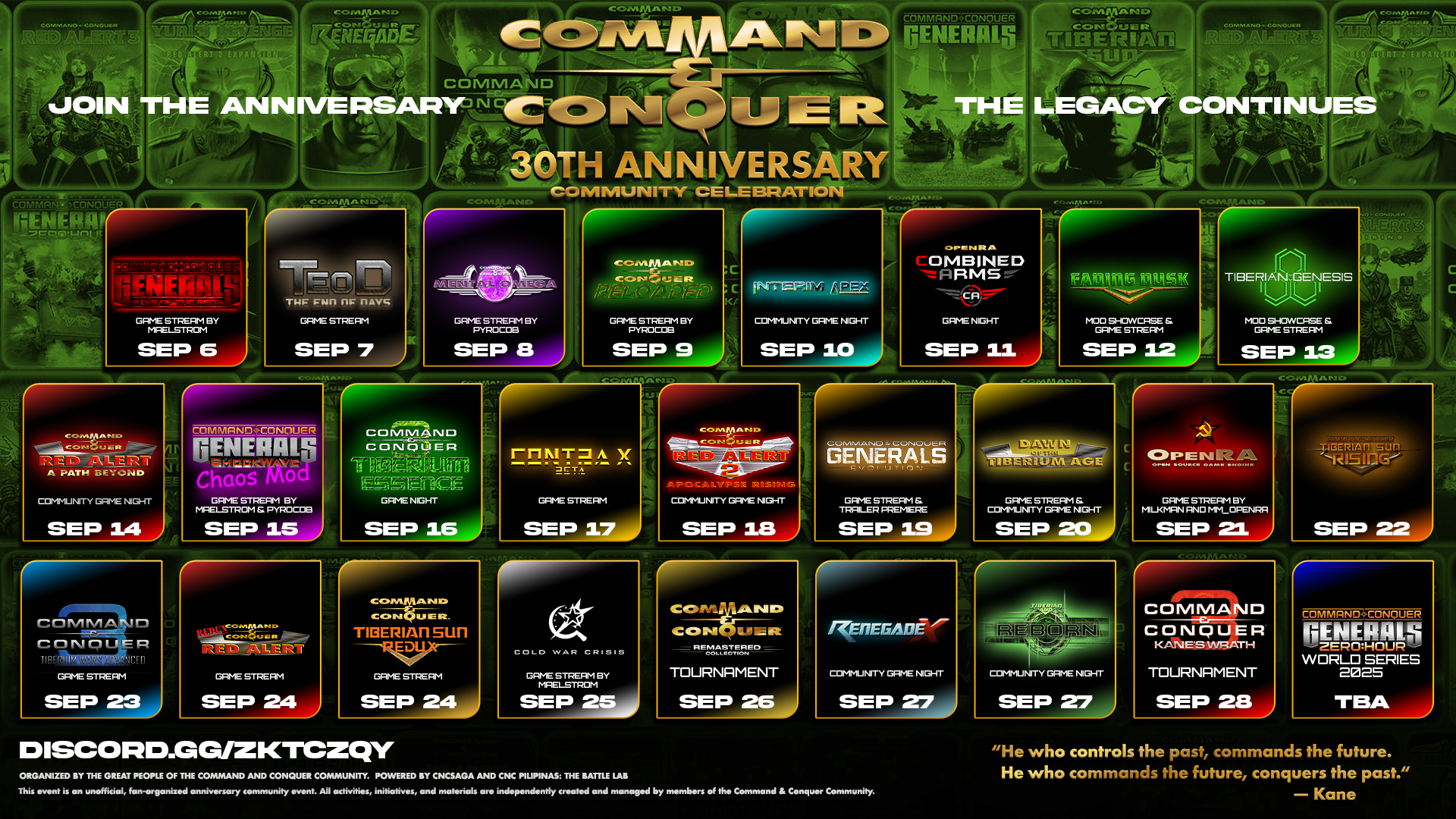
From 6 September, a programme of over two weeks of events centred around the games and mods was on the agenda: community matches, tournaments, mod showcases and live streams. Full details are available on the Command & Conquer Discord.
An anniversary driven by the community
This global event was organised in partnership between CnCSaga and The Battle Lab, with the support of C&C communities around the world. Thirty years after the first mission order, the saga has never been more alive: remasters, award-winning mods, tournaments and fan creations continue to bring the universe imagined by Westwood Studios to life.
Join the celebrations on our Discord and follow the full programme on our social media channels!
Interview with Louis Castle by Alex06
In this interview, lasting around 34 minutes, Louis Castle, co-founder of Westwood, looks back on the origins of Command & Conquer, abandoned projects and the closure of the Las Vegas studio. His account complements that of Erik Yeo, with a greater focus on the studio’s management and the evolution of the franchise. Here are the key points:
- Command & Conquer could have been a fantasy game. Following the success of Dune II, Westwood began a project called Swords and Sorcery. However, Brett Sperry believed that a contemporary military setting would appeal to a wider audience. The idea then became to allow the player to remotely command a battlefield from their computer;
- The setting was intended to depict a credible near future. The artists drew inspiration from military magazines and imagined weapons that armies might already possess in secret. Concepts that were too futuristic were saved for the sequels. Castle explains that the story was envisaged as a trilogy - Tiberian Dawn, Tiberian Sun, then Tiberian Twilight - with technological progress accelerated by the arrival of the Scrins. However, this initial intention did not correspond exactly to the games that were ultimately released;
- Virgin played an important role in the game’s commercial identity. Castle highlights the contribution of his international marketing team, particularly in the choice of the name and the cover art depicting a Soldier. The aim was to emphasise the player’s role as a Commander, with a presentation that was unusual for a strategy game of the time;
-The US military did indeed commission concept art from Westwood. According to Castle, the Department of Defence initially wondered whether the studio had access to internal information on certain weapons systems. After discovering that their sources were public, it offered them a design commission. The collaboration is said to have involved only half a dozen designs: the team chose to stop, as their confidential nature prevented them from being reused in the games;
-The expansion packs proved far more successful than expected. They introduced new missions – some of which had been omitted from the original game – and helped maintain interest between releases. Castle states that sales of the first expansion were around ten times higher than estimated. Red Alert, itself initially conceived as an expansion, became a standalone game as its content and gameplay had grown so substantially; - The three C&C universes each had different aims. C&C: Red Alert drew on the extravagant military experiments and technological fantasies of the Cold War, in a lighter tone. Generals reflected a desire to revitalise the mechanics and tell a more narrative-driven story through cutscenes rendered within the game engine. Castle particularly admires the asymmetrical balance in Red Alert 2: Yuri's Revenge, where three very different factions remain competitive;
- He describes the closure of Westwood as a decision by EA to consolidate its operations. According to his account, the aim was to bring together several studios to pool resources and attract talent. He had advocated for Las Vegas, but Los Angeles was chosen instead. He regrets this choice whilst disputing the interpretation that the closure was malicious. He also points out that Red Alert 2 had been developed primarily by the Irvine team, whilst Las Vegas was working notably on Renegade and Earth & Beyond;
- **The next C&C game conceived in Las Vegas was intended to radicalise the differences between the factions.**The GDI would have had fully mobile bases: buildings would fold up into vehicles, travel in convoys and redeploy in their previous formation. Nod would have relied on scattered, fortified outposts, whilst the Scrin would have focused on rapid raids. Mobility was to be essential for the GDI, which would have struggled to win by remaining entrenched. These ideas were not carried over as such into subsequent games;
-A Command & Conquer MMO was also envisaged. Continuum was intended to allow players to take control of units, drive vehicles and fight in a persistent world, with an approach reminiscent of the multiplayer mode in Renegade. Earth & Beyond served, in particular, to gain experience in MMOs before committing the C&C brand to such a project. The project remained largely at the concept and design stage. Castle is unsure about the use of the name ‘Incursion’: his recollections of project names should therefore be treated with caution; - Ideas were constantly being shared between the games. Mind control, unit experience and upgrades were reused and developed further from one instalment to the next. Castle particularly emphasises the value of making veteran units very powerful, to reward players who keep them in service. He describes this period as a golden age in which several RTS studios drew inspiration from one another and innovated rapidly.
The interview concludes with his desire to return directly to game development: with his small studio, Childlike Wonder Games, he explains that he is working on strategy and simulation ideas, which were still under wraps at the time of the interview.
Interview with Erik Yeo by Alex06
In this interview, lasting approximately 1 hour 25 minutes, Erik Yeo looks back on the creation of Command & Conquer, creative freedom at Westwood and his vision for the future of strategy games. He also discusses several abandoned projects and shares anecdotes from the development process. Here are the key points:
- His entry into the video game industry was entirely spontaneous. Whilst managing a software shop, he met some Virgin employees who had come in to buy games. Recruited as a producer, he suggested so many additional features that he was quickly steered towards game design. He then joined Westwood during the development of The Lion King and, according to his account, became its first full-time designer;
- His experience with consoles influenced the first Command & Conquer. He wanted the player to be immediately immersed in the game’s world: the immersive setup with EVA stemmed in particular from his frustration with the technical set-up requirements of PC games. Commando also reflected his desire to rediscover the pleasure of controlling a character who moves around and blows everything up. The two CDs also meant you could lend a disc to a friend to play together in multiplayer mode;
- The differences between the GDI and Nod were intended to reflect their narrative identities. The GDI represents a conventional army, whilst Nod employs more eclectic and unscrupulous methods. Yeo wanted these differences to be reflected in their units, even if this made balancing them considerably more complicated. Staff who stayed behind to play after work provided him with valuable feedback;
-Westwood operated like a collective laboratory. Artists, programmers and designers contributed beyond their areas of specialism. The secret missions featuring dinosaurs, for instance, began as a technical experiment, to which levels and then a cutscene were added, before management criticised the team for the time spent on this unplanned addition. Red Alert, initially conceived as an expansion, became a full game as ideas and content accumulated; - For Tiberian Sun, his central ambition was to make the terrain strategic and dynamic. Craters, destructible bridges, tunnels and frozen surfaces were intended to force the player to adapt their plans. He would have liked to have gone even further. He also wanted a fully 3D engine, but this proposal was rejected to ensure the game remained accessible on the PCs of the European public at the time. Voxels provided a compromise. He also cites Aliens as a major influence on the atmosphere and artistic direction;
- Several projects were highly ambitious. The initial concept for C&C: Commando, which became Renegade, envisaged one player commanding the battle as in an RTS, whilst the others played the Soldiers on the ground. Westwood had also produced a Star Wars prototype depicting a battle on Hoth using the engine from the first C&C. As far as he understood, the project was reportedly scrapped due to a lack of agreement regarding the publisher;
- His ideal RTS would combine short battles with long-term progression. He envisages intense missions lasting 15 to 20 minutes, possibly in co-op mode, separate from base management and technological research. Resources gathered would be used to create custom units. Dynamic events, such as a ship crash where all players covet the technology, would make the games memorable. These are design ideas, not the announcement of a new game;
-He advocates a design approach based on experimentation and player autonomy. He likes to tinker with prototypes himself before bringing in the programmers, in order to minimise wasted time. What interests him particularly is enabling the player to devise a solution, try it out and see that it works. After Westwood, he mentions Oddworld: Stranger’s Wrath, The Sims 3, The Force Unleashed and Amazon, amongst others. He criticises the monetisation of free-to-play games and expresses enthusiasm for the immersive possibilities of VR.
Two anecdotes provide a particularly fitting end to the interview: **the US Department of Defence’s interest in the C&C units, which resembled systems it was studying, and the urgent delivery of the masters for the first game on the Concorde so as not to miss the manufacturing window. Yeo ultimately describes Westwood as an exceptional convergence of the right people at the right time, with a freedom of creativity that he believes would be difficult to replicate.