Censorship and Generals
Chinese censorship:
Generals has been banned in China, not because of the way the Chinese army is portrayed (the use of weapons of mass destruction, hundreds of Soldiers sent to certain death, etc.), but solely because ‘Tiananmen Square’ is destroyed with a single click: a flagrant disgrace for Chinese officials.
The game, although banned, is very popular in the country… perhaps due to piracy and the internet….
German censorship
In Germany, ‘Generals’ has been banned for under-18s, as it was deemed by child protection agencies to be too violent and too reminiscent of the reality of the war in Iraq for young Germans.
"Introduction:
The Federal Ministry for Family Affairs, Senior Citizens, Women and Youth (BPjS in German: http://www.bmfsfj.de/) is calling for a ban on Command and Conquer: Generals for minors.
The sense of realism:
Command and Conquer: Generals is undoubtedly based on current political conflicts. The first mission in the US campaign appears to have been inspired by the evening news: in the mission description, the player learns that the GLA, stationed in Baghdad, possesses weapons of mass destruction. The player’s task is to destroy the GLA troops and neutralise the weapons of mass destruction.
“Generals” therefore deals with realistic, threatening events for which the only acceptable solution would be war.
“Generals” implies that the Iraqi regime is linked to Islamic organisations. In the game, the GLA is clearly portrayed as representing the Islamic terrorist group Al-Qaeda: their units have Arab features, speak with an Arabic accent and dress in the Arab style, whilst their weapons correspond to those used by Islamic organisations.
Command & Conquer: Generals thus suggests a link between Islamic terrorists and many states in the Middle East and Central Asia. In its presentation, the game implies that war is a legitimate political means: the faces have been rendered unrecognisable in this respect (only the lower part is visible). There are, however, vague resemblances to the faces of George W. Bush and Kofi Annan. Meanwhile, a voice explains that in the modern world, words would resolve conflicts.
A declaration of war appears to be the only option: the GLA is unwilling to engage in peace negotiations despite numerous attempts. Later in the game, the GLA declares itself willing to negotiate with UN representatives solely in order to destroy one of their convoys.
Command and Conquer: Generals is realistic, including in its depiction of weapons, which risks leading children to believe it is real.
The exploits of nuclear Artillery are commented on with frenzied glee.
The explosions are depicted in unprecedented detail. Particularly dramatic explosions are shown in close-up and in slow motion. Mushroom clouds fill the screen. Biological weapons leave behind not only death and destruction, but also dangerous clouds.
The game’s missions are not limited to battles against another army but occasionally require fighting against the unarmed civilian population: in one mission, the GLA must steal money. As the impoverished civilian population depends on these goods, an unequal race begins. Here, the game requires the player to kill civilians and destroy their homes in order to reach the currency that has already been collected. The player is advised to kill fleeing civilians; in this case, the only advantage over simply stealing the money is a saving of time.
Command & Conquer: Generals features a wide array of particularly cruel weapons of war, such as nuclear bombs and chemical weapons… Human casualties are depicted realistically and clearly, albeit on a small scale. As the game has a zoom function, the player can examine the destruction, spectacularly staged within a scene, in even greater detail. Destroyed vehicles send explosions of slain Soldiers flying into the air, whilst the massacred infantry writhe in agony.
Immersion in the game:
Similarly, two GLA members boast to each other about their kills (“I’ve killed three!” “I’ve killed four!”). For every opponent destroyed, the player receives experience points in return, which they can invest in developing more destructive weapons.
Players can challenge each other to online matches and display the medals pinned to their virtual chest. To play online, Command and Conquer: Generals features a well-designed ranking system: players earn points for matches won and time spent playing, and rise through the ranks from Soldier to Senior Commander. Ranks are linked to US Army insignia.
In this way, players can achieve fame and recognition online.
The trivialisation of facts:
Trivialising war can be dangerous for young people; consequently, the glorification of war, death, destruction and the misery of war is equally so.
The greatest fear associated with modern warfare surely lies in the use of biological weapons. These dangers are precisely denied in Command and Conquer: Generals. Instead, weapons of mass destruction are glorified.
The player accepts weapons of mass destruction as a strategic means of destroying as many enemy units or buildings as possible, without questioning the true power of these weapons.
When selecting units, they make comments: the conductor of a Flame Tank remarks that it’s hot inside his vehicle; GLA workers ask if they can be given some shoes. One might therefore wonder whether Generals might simply be satirical. But upon hearing the patriotic comments from American Soldiers, one realises that the game is simply cynical.
Conclusion:
In summary, the panel found that glorifying realistic and cruel war scenarios – particularly through the playful use of weapons of mass destruction and a particularly Machiavellian attitude towards non-combatants – sufficient evidence to suggest that this game has a numbing effect and that such content may influence children and young people.
Based on the current state of research, no definitive conclusions can be drawn and it is not possible to provide a clear answer regarding the effects induced by the game. However, based on the results analysed so far, only a few of the trends outlined above have been confirmed.
Children who had previously played Street Fighter are less sensitive to emotions than those who played Yoshi.
Children whose sensitivity towards others is slightly impaired already have a great deal of experience with video games, particularly aggressive ones.”
EA’s response:
The game had been tested prior to its release on 14 February 2003 by a regulatory body responsible for software sold to under-16s.
“We are extremely surprised by this unprecedented measure, as the statements made by the Ministry of Family Affairs, represented by Minister Schmidt, are partly false and unfounded.”
Dr Jens Uwe Intat, EA’s director for Central European countries, now hopes that the BPJS will reverse its controversial decision:
“We are aware that the BPjS is under considerable political pressure in this matter, but we nevertheless have every confidence in its competence and objectivity, as well as in its chairpersons, who will soon be reviewing this decision once and for all.”

EA strikes back...
Faced with this unjust ban, EA has retaliated by releasing CnC Generäle: this is a ‘cleansed’ version of the game, from which everything that might cause offence has been removed...
1.1. Place names have been replaced with fictional names:
“Al Hanad in Yemen” becomes “city in the desert”,
“Kabara” > “Kathallra”,
“Le Barrage des trois gorges” → “Le Barrage des trois turbines”,
“Yangtze” → “Jongongse”,
“Chengdu” → “Chejingdsu”,
“Balykchy” → “Hive City”,
“Bishek” → “Ramkek”,
“Aldastan” → “Betastan”,
“Astana” → “Tarmah”,
“Aral Sea” > “Northern Sea”,
“Baikonur” > “Rocket Launch Site”,
“Baghdad” > “Twin Sword City”,
“Washington” > “Headquarters”
1.2. All factions are replaced with fictional names:
"USA" > "W.A. (Western Alliance)",
"China" > "AP (Asian Pact)",
"GLA" > "IBG (International Liberation Group)",
"UN diplomats" > "Diplomats"
1.3. Units/weapons are replaced with fictional names:
"Warmaster" > “Battlemaster-Panzer”,
“Toxin Tractor” > “Acid Tractors”,
“Red Guards” > “Cyborgs”,
“Anthrax” > “acid”,
"Bacteriological shells" > "Acid shells"
2.1. All civilians have been removed from the game.
2.2. The mission involving the UN lorries has been removed.
3.1. All human units have been replaced by robots.
3.2. Voices are digitised and rendered unrecognisable, and no longer sound like human voices.
3.3. Phrases such as “I’m hungry” and “My hammer is too heavy” are removed.
3.4. Kamikaze units are replaced by remote-controlled charges.
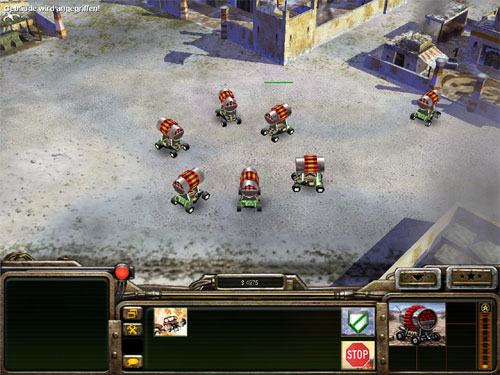
3.5. Depictions of human units are rendered unrecognisable.
3.6. Human names have been altered, for example:
“Colonel Burton” > “Kommandobot”,
“The rioters” > “Cyborg-Trupp”,
“Ambulance” > “Repair unit”,
“Terrorists” > “Activists”,
“The Black Lotus” > “Black Bot”,
“Worker” > “Arbeitsbot”,
“Jarmen Kell” > “Infiltrator”,
"Rebels" > "Cyborgs",
"Rocket Soldier" > "Raketen-Bot"
Please note that there is already a Patch available to restore all the settings for CnC Generals if you own CnC Generals.
Finally, the CnC Generäle expansion pack is called “CnC Generäle: Die letzte Stunde”. There is only a German-language version (streamlined edition) for Germany, Austria and Switzerland...